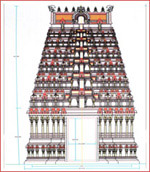
భారతదేశపు చారిత్రాత్మక దేవాలయాలు
Showing posts with label History. Show all posts

Katas Raj Temples, Chakwal, near Lahore, Punjab

Katas Raj Temple is situated in Chakwal district of Punjab in Pakistan. Dedicated to Lord Shiva, the temple has existed before the days of Mahabharata and the Pandava brothers spent a substantial part of their exile here.

It is said that the five Pandava brothers, heroes of the Historical epic Mahabharata, stayed here four out of the 14 years that they spent in exile.

Its origin involves the death of Shiva's wife Satti. When she died, Shiva cried so much and for so long, that his tears created two holy ponds - one at Pushkar in Ajmer, India and the other at the Katas Raj Temple.

Gorakhnath Temple, Peshawar - Pakisthan

Gorakhnath Temple, Peshawar, NWFP

A historic Hindu temple in Peshawar city of northwest Pakistan, which was re-opened on the orders of a court last year, has been vandalised by unidentified men in the third such attack on the shrine in the past two months.

The attackers burnt pictures inside Gorakhnath Temple and took away idols from the shrine located within an archaeological complex in Gor Gathri area on Sunday, leaders of the Hindu community said.

The shrine’s custodian told the media that this was the third attack on the temple in the past two months. Police officers visited the temple to probe the incident.
Hindu leaders urged police to put in place better security measures to prevent such incidents.
The temple’s custodian told police that he had seen a group of eight men inside the temple when he arrived there at 6:30 p.m.
The men started burning pictures and holy books before fleeing with some idols, he said.
Members of the minority Hindu community rushed to the temple.
Footage on television showed burnt papers and utensils lying strewn on the floor of the temple.
The 160-year-old temple was re-opened for Hindus last year on the orders of the Peshawar High Court. It had been closed since Partition.
The temple was reopened after Phool Wati, the daughter of the shrine’s cleric, petitioned the High Court. 

Courtesy:The Hindu

GOD PARTICLE mentioned in VEDAS

Scientists at the massive Large Hadron Collider under the Swiss Alps have easily replicated the innovative mini-Big Bang results of a previous experiment which created the ‘primordial soup’ of the just-born universe.
God Particle
Super-hot ‘quark-gluon plasma’ is believed to have existed just nano-seconds after the Big Bang, and to have formed the stuff of galaxies, planets, suns, and all life forms. Such new data on the birth of the universe is pouring in from the experiments, leading physicists to consider extending the current phase of the project for two more years.
The new results took only days of colliding lead ions in the massive machine at ultra-high energies, and produced temperatures 500,000 times higher than in the sun’s core. The resultant mini-Big Bangs were even more intense than those caused using hydrogen protons during the Collider’s first seven months of operation.

The planned two-year extension could result in earlier discovery of the Higgs Boson particle believed to be the stimulus which changed the initial fabric of the universe, an amorphous mass of particles, into solid matter.
 
Lord Sree Maha Vishnu
According to CERN Director General Rolf Heuer, scientists working on the project want to maintain the momentum of the new discoveries, as everything previously understood has now been confirmed and new territories are waiting to be explored. The ‘known unknowns’ are coming into view, and the as yet unimaginable lies beyond.
The Large Hadron Collider is at present being shut down for its regular winter maintenance schedule and experiments will recommence in February next year.

Why do we Celebrated Maha Shivarathri (Legendary Story-1)

In the Shanti Parva of the Mahabharata, Bhishma, whilst resting on the bed of arrows and discoursing on Dharma, refers to the observance of Maha Shivaratri by King Chitrabhanu. The story goes as follows - Once upon a time King Chitrabhanu of the Ikshvaku dynasty, who ruled over the whole of Jambudvipa, was observing a fast with his wife, it being the day of Maha Shivaratri. The sage Ashtavakra came on a visit to the court of the king.

The sag asked the king the purpose of his observing the past. King Chitrabhanu explained that he had the gift of remembering the incidents of his previous birth.
Shiva Lingam


The king said to the sage that in his previous he was a hunter in Varanasi and his name was Suswara. His only livelihood was to kill and sell birds and animals. One day while roaming through forests in search of animals he was overtaken by the darkness of night. Unable to return home, he climbed a tree for shelter. It happened to be a Bael tree. He had shot a deer that day but had no time to take it home. So he bundled it up and tied it to a branch on the tree. As hunger and thirst tormented him, he was kept awake throughout the night. He shed profuse tears when he thought of his poor wife and children who were starving and anxiously waiting for his return. To pass away the time that night he engaged himself in plucking the Bael leaves and dropping them down onto the ground.

The next day he returned home and sold the deer and then bought some food for himself and his family. The moment he was about to break his fast a stranger came to him, begging for food. He served the food first to stranger and then had his own.

At the time of his death, he saw two messengers of Lord Shiva. They were sent down to conduct his soul to the abode of Lord Shiva. He learnt then for the first time of the great merit he had earned by the unconscious worship of Lord Shiva during the night of Shivaratri. The messengers told him that there was a Lingam at the bottom of the tree. The leaves I dropped fell on the Lingam. His tears, which had shed out of pure sorrow for his family, fell onto the Lingam and washed it and he had fasted all day and all night. Thus, he unconsciously worshiped the Lord.

As the conclusion of the tale the King said that he lived in the abode of the Lord and enjoyed divine bliss for long ages and now he has reborn as Chitrabhanu.

Definition of GOD

God is a word that means different things to different people. To many Taoist or Buddhist the word is not part of their religion's glossary. To Hindus that word has a different meaning than it does to a Christian. Muslims have a different perspective and so do the Jews. So for the purpose of The Mystic Doctrines website, we need a common definition of God.

Quoting different sources from each religion before revealing the definition.

Taoism

Tao, the subtle reality of the universe cannot be described, That which can be described in words is mearly a conception of the mind. Although names and descriptions have been applied to it, the subtle reality is beyond the description.
Tao Teh Ching - beginning of chapter 1


The subtle essense of the universe is elusive and evasive.
...
It is the subtle origin of the whole of creation and non-creation. It existed prior to the beginning of time as the deep and subtle reality of the universe. It brings all into being.
Tao Teh Ching - portions of chapter 21


Buddhism

"There is, O monks, an unborn, unoriginated, uncreated, unformed. Were there not, O monks, this unborn, unoriginated, uncreated, unformed, there would be no escape from the world of the born, originated, created, formed.
"Since, O monks, there is an unborn, unoriginated, uncreated, and unformed, therefore is there an escape from the born, originated, created, formed."
The Gospel of Buddha - Sermon at the bamboo grove at Rajagaha


Hinduism

Neither the multitude of gods nor great sages know of my origin, for I am the source of all the gods and great sages.
A mortal who knows me as the unborn, beginningless great lord of the worlds is freed from all delusion and all evils.
The Bhagavad-Gita - The tenth teaching, verses 2 & 3

Sihkism

There is One, only One Supreme Being, Truth Eternal, Creator of all seen & unseen, Fearless, Without hatred, Timeless Being, Non-Incarnated, Self created, Realized by the Grace of Guru (Perfect Master Only.)
Guru Granth Sahib Page 1

Judaism

In the beginning God created the heavens and the earth.
Genesis 1:1


For thus saith the Eternal that created the heavens; God himself that formed the earth and made it; he hath established it, he created it not in vain, he formed it to be inhabited: I am the self existent One; and there is none else.
Isaiah 45:18


Christianity

In the beginning was the Word, and the Word was with God, and the Word was God Himself. He was present originally with God. All things were made and came into existence through Him; and without him was not one thing made that has come into being.
Gospel of John 1:1-3


Sufism

You are the Absolute Existence which causes (our) transient (existences) to appear.
Masnavi - Book 1 - Creator and Creation
Now, a definition of God.

God is the indescribable, uncreated, self existent, eternal all knowing source of all reality and being.

Courtesy: http://reluctant-messenger.com

Sri Venkateswara Swami Temple - Pittsburgh, USA


About the Temple
Sri Venkateswara Temple (S. V. Temple) is located in Penn Hills, an eastern suburb of Pittsburgh, PA, USA. It is one of the earliest traditional Hindu Temples built in the United States.
Sri Venkateswara Swami Temple, Pittsburgh, US
History
Sri Venkateswara Temple organization was established on Aug 7, 1975. Assistance from Tirumala Tirupati Devasthanam (TTD) for construction of the temple was requested on Sept 11, 1975 and granted on the same day. On June 30, 1976 ground breaking was performed and was followed by pratisthapana on Nov 17, 1976. Daily worship is being performed continuously ever since.
Other significant events are:
June 8, 1977Kumbhabhishekam
October 22, 1978Dedication of Rajagopuram
May 28, 1979Dedication of Pushkarini
August 31, 1986Sahasrakalasabishekam
November 17, 198610th Anniversary Celebration
March 22, 1989 to May 21, 1989Jirnodharanam
May 25, 1989Kumbhabhishekam
August 25, 1989 to September 3, 1989Ashtalakshmi Pooja and Sudarsana Homam
November 23, 1990Srinivasa and Padmavati Mahakalyanotsavam
November 23, 1990Inauguration of the Auditorium and Kalyanamandapam
May 25, 1991 to May 27, 1991Maha Satyanarayana Pooja
October 26, 2001 to October 25, 200225th Anniversary celebrations: Year long Tulasidala Archana, Koti Tulasidala Archana, Ashtakshari Mahamantra Yagna Sri MahaVishnu Viswashanti Yagna and Maha Yagna, Sahasra Rajata Kalashabhisekham
August 26th to 30th, 2009Kumbhabhisekham


S. V. Temple was constructed at a cost of several millions of dollars with donations raised from devotees in U.S.A and several countries. Most donors were first generation Indian immigrants seeking to maintain ties with their mother culture.

Structure
Plans for Sri Venkateswara Temple were designed and planned by Sthapathy Ganapathi working at engineering cell of endowments department, Andhra Pradesh, India, on Aug 2, 1973. Sri Venkateswara Temple, Sri Tayar (Lakshmi) Temple, Sri Andal temple are their design, which is different from Sri Venkateswara Temple in Tirupati, Andhra Pradesh, India. Click here for floor plan
Agama
A Hindu Temple is constructed according to the Agama Sastras (Temple manuals) in the image of the human body. The two sides of the temple represent the hands, and the top of the Temple represents the head. The deity Venkateswara (Lord of Venkata, and a representation of Vishnu) rests in the innermost recess called the Garbhagraha (sanctum sanctorum). The S. V. Temple at Pittsburgh follows the temple texts known as Pancharatra Agama which consists of 108 samhitas (collection).
Archa  Roopam
The Agama state that Narayana, the eternal Divine Being, should be worshipped in the Archa Roopam (iconic form) in temples and homes. Hindu devotee believes that divine power has manifested itself in the murti (icon/idol). Major religious events like Kumbhabhishekam are performed to re-energize the Murti with Divine Power, which can either be diluted or lost due to transgressions committed unknowingly by the priests or the worshippers. Worshipping the Archai Avatara as Hari gives the devotees access to God and His Power.
Priests
Rules of Agama require a temple priest to serve and act as an intermediary between the worshipper and God. The Vaishnava Temple priests are referred to as Bhaktacharya, Bhattacharya or simply Bhattar. They come from families with Temple priesthood as their traditional occupation, and learn their skills from a young age. All the daily and weekly rituals are performed by the priests. Special occasions such as  Kumbhabhishekam require additional priests, who are then invited from other Temples in the United States and India.
Worship
Several types of religious services performed at the Temple: Archana, Abhishekam, Sathyanarayana Puja, Kalyana Utsavam, Homa and many others which are published under "Services", "Programs & News" menu items in this website. 


Courtesy: http://www.svtemple.org

The Parashakthi Temple - USA

Mahishasura Mardhani Alankaram
The Parashakthi Temple, also known as the Eternal Mother Temple was built in 1999 and the inaugural pooja took place in October 1999. The temple has several deities and the murthy pratishtas have been conducted for these deities through the years since the temple’s inception. Since then, thousands of devotees have flocked to see Mother to shower Her with their love and devotion. Several devotees have experienced many miracles at the temple and throng every week to participate in the Abhishekams and other special functions that are conducted throughout the year. 
Gopuram

Every significant event in their lives, such as the purchase of a new home or a wedding or the birth of a child, the purchase of a new car, etc.,are celebrated by obtaining the blessings of Divine Mother Parashakthi.


Primary Deity - Parashakthi Karumari Amman - Divine Eternal Mother (Heart of Divine Love) 
Parashakthi Karumari Amman
Our Divine Mother Parashakthi is "Divine Pure Eternal Consciousness" who created and manifested as our universe. She manifested as Shiva Shakthi and formed a ParaBindu, which separated into Shiva and Shakthi. All the Gods and Goddesses are her manifestations of various vibratory divine entities. At our Temple she is present as Parashakthi Karumariamman who is closest to the earthly creations and is able to grant us divine vibrations. In this form, we, as separate "Atma" (individual soul) can communicate with "Paramatma" (supersoul) through Her which will ultimately lead to our union with Her by Her Grace.

Courtesy: www.parashakthitemple.org 

About Lingam - The Holy Symbol of Lord Shiva


Shiva Lingam

The frame of the cosmic reality, according to ancient Hindu thought, consists of the three fundamental states called evolution (Shrishthi), existence (sthiti), and involution (samhara) that acts in a cyclic process of infinity. Each one of the forms is controlled by a God, named Brahma (the creator), Vishnu (the preserver) and Siva/Shiva (the destroyer); these three Gods are called the Trinity. Shiva, being the last to complete the cycle from where the new cycle starts, is known as Mahadeo, the Supreme Divinity. The iconographic form of the Shiva, the Linga represents the unity of the three states of cosmos (shown in above figure).The Linga consists of the three parts. The first is a square base of three-layers at the bottom showing the three mythical realms (lokas), symbolizing evolution the place of Brahma. The second is an octagonal round form in the middle showing the eight directions, symbolizing existence or perseverance the place of Vishnu; and third is a cylinder at the top with a spherical end, symbolizing involution or completion of the cosmic cycle the place of Shiva. This icon shows the supreme state of integrity, the ultimate form of Shiva linga itself is a symbol of cosmic mandala. As Sadasiva (eternal reality) Shiva is represented as linga, standing also for 'total knowledge'. As Rudra, the destroyer, his consort is Kali. As Bhairava, the terrible destroyer, his consort is Durga. As a jovial god living in the Himalaya his wife is Parvati. As possessor of all forms of divine power Shiva rooms at the bottom of everything that is moving, that is how he is called Ishvara, derived from I-cara, i.e. I the centre, and cara, the rhythm of movement. Shiva is also depicted as cosmic dancer, Tandava Nartakari, the one who keeps up the rhythm of the world in cosmos.

Shiva Linga is the holy symbol of Lord Shiva that is considered sacred by the devotees of Lord Shiva. The word, ‘Lingum’ in Sanskrit means, ‘symbol’. Shiva Lingum, therefore means symbol of Lord Shiva and is therefore considered most sacred by Shaivaites. Siva Linga has been worshipped in Hinduism since ages. Worship of Shiva Linga is regarded sacred and superior Shiva Mahapurana. This is because the form makes worship simple while maintaining the truth that God does not have any definite form.

Structure of Shiva Linga Most prevalent icon of Shiva and virtually found in all Shiva temples, Shiva Linga is a rounded, elliptical, an-iconic image that is usually set on a circular base or peetham. According to some scholars the Peetham represents Parashakti, the manifesting power of God. Shiva Lingas are usually made of stone that may either be carved or naturally existing - svayambhu, such as shaped by a swift-flowing river. Shiva Lingas may also be made of metal, precious gems, crystal, wood, earth or transitory materials such as ice. Some scholars say that transitory Shiva Linga may be made of 12 different materials such as sand, rice, cooked food, river clay, cow dung, butter, rudraksha seeds, ashes, sandalwood, darbha grass, a flower garland or molasses.
Various Interpretation of Shiva LingaBesides regarding Shiva Linga as the symbol and form of Lord Shiva, religious scholars have given various interpretations of Shiva Linga. Here is the brief description of some of the popular theories and interpretations related to Shiva Linga and its origin:

Worship of the Phallus
According to some scholars, worship of Shiva Linga in effect means worship of the reproduction function. For, they say that the other meaning of the Sanskrit word ‘Linga’ is gender in general and phallus (the male reproductive organ) in particular. They believe that the base of the Lingam corresponds to the Yoni which mean vagina or the female reproductive organ. Correspondence of Linga and Yoni in a Shiva Linga is therefore interpreted as the representation of the process of copulation. Scholars further opine that the Kalash (container of water) that is suspended over the Shiva Linga from which water drips over the Linga also correspond to the idea of intercourse.
Connecting the origin of Shiva Linga to the early Indus Valley civilization, scholars opine that tribes of the Indus Valley took to the togetherness of Lingam and Yoni in a Shiva Linga as the point of energy, creation and enlightenment.

Interpretation in Tantra
According to Tantra, Lingam is a symbol of Shiva's phallus in spiritual form. They say, the lingam contains the soul-seed within which lies the essence of the entire cosmos. The lingam arises out of the base (Yoni) which represents Parvati according to some or Vishnu, Brahma in female and neuter form according to others.

Interpretation in Puranas
Puranas, especially the Vamana Purana, Shiva Purana, Linga Purana, Skanda Purana, Matsya Purana and Visva-Sara-Prakasha attribute the origin of Shiva Linga to the curse of sages leading to the separation of and installation of the phallus of Lord Shiva on earth. Some also refer to the endlessness of the lingam to be linked to the egos of Lord Vishnu and Lord Brahma.

Interpretation of Shiva Linga as an Abstract Symbol of God
Some scholars of the Hindu scriptures say that Linga is merely an abstract symbol of the God. They point towards several legends in Hinduism where a sundry rock or even a pile of sand has been used by as a Lingam or the symbol of Shiva. Citing a particular instance they say, Arjuna once fashioned a linga of clay when worshipping Shiva. Scholars of Puranas, thus argue that too much should not be made of the usual shape of the Lingam. Scholars say that the interpretation of Shiva Linga as an abstract form of God is also consonant with philosophies that hold that God may be conceptualized and worshipped in any convenient form. The form itself is irrelevant, as the divine power that it represents is all that matters. Scholars thus say that Sivalinga represent the formless Nirguna Brahman or the formless Supreme Being.

Special Note: 
Above all information regarding Shivlinga and it's description has been taken from "The Linga Puran"

About Rudraksha — The Eye of Rudra [Lord Shiva]

Rudhra - Lord Shiva
Rudraksha meaning—the eye of Rudra [Shiva] is considered to be the most potent anifestation of the Cosmic Force. Hence Rudraksha is the object of veneration and also the source to reach the higher self. Rudraksha is often believed to symbolize the link between the earth and the heaven. These beads are the seeds of the Rudraksha fruit obtained from Rudraksha trees. The Rudraksha tree is botanically known as ELAEOCARPUS GANITRUS ROXB. Its English name is UTRASUM BEAD TREE.

Rudraksha trees are mostly found in South Eastern Asian Islands of Java, Sumatra, Borneo, Bali, Iran, Java, Timor (Indonesia) and parts of South Asian Kingdom of Nepal. Around 70% of the Rudraksha trees are found in Indonesia, 25% in Nepal and 5% in India. Considered a major stress reliever, reducing circulatory problems and of course as the best beads, the berry (Elaeocarpus Ganitrus) was first spotted in Indonesia and is now grown in Nepal and Hardware. However, because it is expensive, clinical research of its medicinal properties has not been possible, often resulting in the berry being subjected to esoteric mumbo jumbo.

There are clefts called Mukhi on the surface of the beads. The number of Mukhi on the surface of a Rudraksha beads helps in determining its quality. According to the number of Mukhi the Rudraksha bead ranges from single face to a several faced bead. Asians have used Rudraksha beads traditionally. Asian Yogis and Monks found that merely wearing the Rudraksha beads gave them astonishingly tremendous amount of tranquility, concentration that helped them meditate for a long period of time with spectacular control over their mind.

Properties of Rudraksha

Scientific research says that Rudraksha beads have some electrical and magnetic powers. Researches also say that when there is a difference in the faces seen in Rudrakshas then they have different electromagnetic properties. Rudraksha beads are composed of carbon, hydrogen, nitrogen, oxygen and some trace elements. Rudraksha bead are available in 1 to 108 faces, however currently 2 to 21 faces are only available in common. Single faced Rudraksha seed is rarely available, while some people claim that 22 to 108 faces Rudraksha plants are still found in the foot hills of Himalayas and Mansarovar regions.

Instructions , Precations to wear : 
Once you have managed to obtain a high quality, empowered and energised Rudraksha, it is of extreme importance that you take certain precautions in order to get the maximum benefit from it and maintain its sanctity.

BEFORE wearing the Rudraksha for the first time, it should be blessed and empowered by chanting the specified mantra, performing the prayers and ritual rites for its sanctification. 

ALWAYS keep the Rudraksha oiled... After regular cleaning, oil the bead and treat it with incense. This is of UTMOST importance. especially when not using the bead for sometime, or storing it for a while. 

ALWAYS wear the Rudraksha bead around the neck in a thread or gold or silver. Never wear the Rudraksha in form of bracelet. 

ALWAYS keep your Rudraksha clean. Dust and dirt can settle in the pores of the bead. Clean these as frequently as possible with something with soft, fine bristles. If the thread becomes dirty or worn out, change it.

AFTER cleaning, wash your Rudraksha with some blessed holy water. This helps maintain its sanctity.

NEVER wear the Rudraksha while having sex. 

WOMEN must not wear the Rudraksha during their menstrual cycle.

NEVER wear the Rudraksha to a funeral or when visiting a new born baby.

Find Different Types Of Rudraksha or Mukhas

One mukhi: One mukhi rudraksha is ruled by Mahadev Himself. Enlightens the Super Consciousness. Destroys all sins and leads one to liberation. One mukhi rudraksha is Sakshat Siva swarupa. The wearer elevates in awareness and merges with the absolute consciousness of the divine. It is only with grace of Lord Shiva and divine karmas that a person gets to wear this rare bead. One who wears it surely goes to path of Moksha. This bead works on the Sahasrar chakra to align oneself to Shiva. The wearer’s mind begins to concentrate on the Supreme Element that is Partattva Dharana cha jayate Tatprakashnam thus the discoverers of Aatma Tattva must wear One Mukhi Rudraksha . This is the best of all Rudrakshas for meditation and spiritual growth . The person who wears this has all worldly pleasures at his feet but remains unaffected by them.


Two Mukhi: Two mukhi represents Ardhanareshwar, a joint image of the Lord Shiva and Shakti and blesses the wearer with 'UNITY' and harmony. It could be related to Guru-Shishya, parents-children, husband-wife or friends. Maintaining ONENESS is its peculiarity. This rudraksha removes the malefics of planet moon and cures emotional instability . Releases fear, insecurity and gives inner happiness and fulfillment.

Three Mukhi: Three mukhi Rudraksha represents "Fire" God Agnidev. Wearing of this rudraksha frees the person from bondages of his past birth karma and paves way for success by deeds in this birth. It is said that the wearer of 3 mukhi never takes birth again, means he gets Moksha. Agnidev rules over planet Sun, so this rudraksha removes malefics of Sun. Wearer is released from low self esteem, stress and anger. Cures diseases related to stomach and liver. 


Four Mukhi: Four mukhi represents the four faced God Brahma. The wearer gains power of knowledge and creativity . Expands memory power, vocal power, wit and intelligence. Wearer is blessed with melodious speech. Lord Brahma rules over planet Jupiter, so four mukhi removes malefics associated with Jupiter. 

Five Mukhi: Five mukhi represents Rudra Kalagni. This highly auspicious rudraksha is important for people who wish to discover their higher selves meaning UpaGuru. Enhances awareness, memory , word power and intellect. This it is extensively used in malas for wearing and chanting mantras. This highly auspicious rudraksha connects wearer to grace of Lord Shiva. Removes malefics of planet Jupiter. 

Six Mukhi: 6 mukhi rudraksha is ruled by Lord Kartikeya and pacifies planet Mars. Gives wearer stability in life with willpower, grounding and focus. Makes wearer free from mental lethargy and emotional instability. Increases connection with mother earth. Wearer gets luck and assets of properties and vehicles. 

Seven Mukhi: Seven mukhi Rudraksha represents Goddess Mahalaxmi , the Goddess of wealth. Wearer is blessed with good health, wealth and new opportunities. It should be worn by those who are suffering from miseries related to finance and luck. By wearing Seven Faced Rudraksha the person progresses steadily in life with name and fame and abundance. 

Eight Mukhi: Eight mukhi Rudraksha represents Lord Ganesha and planet Ketu. Removes obstacles in path and brings success in all undertakings. His opponents are finished, means their minds and intentions are changed to favourable ones. Wearer is blessed with self power, focus, grounding and divine knowledge. 

Nine Mukhi: Nine mukhi Rudraksha is ruled by Navdurga, according to Jabaloupanishad and ruled by Bhairav according to various Shastras. The wearer is blessed with lots of energy, powers, dynamism and fearlessness, which are needed to live a life of success. Gives Bhogha (worldly comforts) and Moksha (liberation). Removes malefics associated with planets Rahu. 

Ten Mukhi: Ten mukhi rudraksha is ruled by Lord Krishna, Yama (God of death), Dus Mahavidyas and the ten directions. One who sees it or wears it gets eternal peace. This rudraksha works like a shield on one's body and the wearer gets immense protection from negative energies . Gives success in court cases, land deals and relieves wearer from debts and losses. This rudraksha is mentioned in ancient texts as one of the most powerful rudraksha which pacifies all the nine planets. 

Eleven Mukhi: 11 mukhi is ruled by the 11 Rudras. According to ancient texts the fruit obtained after performing 1000 Ashavamedh Yagya and 100 Vajpaye Yagya is obtained by wearing this bead. Blesses wearer with high level of awareness, divine consciousness, wisdom, right judgment, control over all senses, powerful vocabulary, adventurous life, fearlessness and success. Very much sought after bead for meditation and sadhanas. This powerful bead pacifies malefics of all planets. 

Twelve Mukhi: 12 mukhi Rudraksha is ruled by Lord Sun. Wearer gets the quality of the sun - to rule and shine with brilliance, radiance and power . Releases stress, anger, worries, suspicion and low self esteem. Wearer is blessed with confidence, self power, energy and motivation in life. 

Thirteen Mukhi: 13 mukhi Rudraksha is ruled by Lord Kamadeva. Fulfills worldly desires of the wearer. Gives hypnotic power of attraction (Vashikaran) to the wearer and blesses him with divine charisma and immense power. Also used to awaken many Siddhies and raise Kundalini energy.

Fourteen Mukhi: 14 mukhi Rudraksha is the most precious divine gem - Deva Mani. It is said to have born from the third eye of Lord Shiva. It is ruled by Lord Shiva Himself and mighty Hanuman and removes malefic s of planet Mars. The wearer is honoured by Gods due to the merit of this rudraksha. It awakens the sixth sense organ by which the wearer foresees the future happenings. Blesses wearer with perfect decisions, spiritual insight and psychic powers. Its wearer gets rid of all the calamities, miseries, worries. It protects from ghosts, evil spirits and black magic. It provides the wearer safety, security and riches and self power.
In Ramayana it is mentioned that Hanuman saved the nine planets during the war from the clutches of King Raavana. And as a favor for saving them, the planets blessed Lord Hanuman by saying that any malefic effects of the 9 planets can be averted by praying to Lord Hanuman alone. It is a very powerful antidote for Mars miseries and provides miraculous cures to several ailments. 


Fifteen Mukhi: This bead is form of Lord Pashupatinath. This rudraksha bead heals the heart chakra. The wearer gets freedom from grief, loneliness, depression and ailments related to the heart. Wearer gets fulfillment of his innermost desires, success, name and fame. The wearer elevates himself from worldly attachments and can focus on knowledge, creation and wealth generation. Pashupatinath Shiva is Lord of animals. He kills the animal instincts within us which is desire to possess and expectations from others.
For: Those suffering from symptoms of blockage of heart chakra due to expectations from others which manifests as Grief, feeling of neglect, loneliness and depression at the emotional level. Physical ailments can manifest as fevers, asthma, diabetes, allergies, heart ailments, lung problems, dysfunction of thymus or immune gland, problems in circulatory system, common cold, blood pressure, anemia, giddiness, sinus disorders, respiratory illness or hypertension. Also for diseases of blood cancer, epilepsy, tuberculosis, Multiple Sclerosis and jaundice which manifest due to blockage of heart chakra. 

Sixteen Mukhi: 
For: Cure of diseases , protection , release of fears and insecurities . Liberation from the fear of death. 16 mukhi rudraksha is Mahamrityunjaya form of Lord Shiva. The wearer becomes fearless & gets victory against the most fearsome of diseases and most adverse circumstances . It protects from physical illness , negative people and negative energies . This protects from physical illness due to placement of planets . If one has fear of loss of a loved one or fear of loss of name and fame or loss of faith in oneself or God or fear of death , or nightmares then one should wear the mahamrityunjaya rudraksha which is 16 mukhi . Wearing this rudraksha is equivalent to chanting the Mahamritunjaya mantra 125000 times everyday . Even Yama the Lord of Death turns back from the wearer of this rudraksha .The path of the wearer become surmountable by grace of Lord Shiva and he rises in Victory and grace.

Seventeen Mukhi: 17 mukhi rudraksha is ruled by Katyayani Devi , the sixth form of Durga . Person who worships this form of goddess attains all the four fruits, ‘Dharma’, ‘Artha’, ‘ Kama’ and ‘Moksha’. This Rudraksha destroys the limiting beliefs of the wearer in gradual course of time and thus destroys past Karma . Wearer becomes a jivanmukta, a liberated person while still alive. He or she will obtain the 8 great paranormal powers (siddhis) and the 32 minor paranormal powers." On a psychic level, it controls the superior intuition, clairvoyance, telepathic capacities, self-control, mental understanding through intellectual identification, creative intelligence. 
Very beneficial for project leaders, businessmen and political leaders and people desiring growth in career . Blesses wearer with immense power of creation of wealth and divine magnetism . Gives fulfillment of all desires related to getting a life partner , progeny, good luck and prosperity.

Eighteen Mukhi: This rudraksha is form of Goddess Bhumi Devi who is the divine wife of Lord Vishnu. This is one of the most powerful rudraksha for prosperity. Katyani tantra mentions that wearer of this bead gets health, intelligence and prosperity by blessings of mother earth. Since it is mother earth who nurtures every being on this planet, wearing Her rudraksha quickly paves way for success in business, land dealings and immense wealth.
This bead has power to provide relief in diseases like diabetes, arthiritis and paralysis.
For: Immense abundance. Profit from land/real estate/own business.

Nineteen Mukhi: 19 mukhi is form of Lord Narayan the supreme of all gods. The wearer never has lack of anything in life. It gives immense wealth, success in business , abundance in all spheres and good health . The wearer gets blessings of Vishnu and Goddess Laxmi and is blessed with many virtues , beauty and prosperity. The wearer gets freedom from dreaded diseases as this bead opens most of the chakras in the body . The wearer attracts perfect life partner . It removes obstacles in job/business/education and removes planetary afflictions. The wearer gets Moksha.

Twenty Mukhi: This rare Rudraksha is ruled by the Creator of the Universe , Lord Brahma. Gives blessings of attainment of divine knowledge in Creation, sciences, arts and music. Wearer becomes the Creator with immense knowledge and intellect . Wearer is blessed with immense power, wealth and fulfillment of desires . Worn by those who desire to manifest projects for the benefit of humanity.

Twenty One mukhi: This rare Rudraksha is represented by Kuber. The wearer is blessed with immense prosperity and fulfillment of pleasures and materialistic desires. Removes all kinds of diseases . Even if a poor person wears it, he becomes rich. Gives the wearer immense protection from any kind of tantra and malefics. Kuber is the guardian of wealth . Without His consent , even Mahalaxmi cannot give wealth. Lord Shiva has blessed Lord Kuber. He is the chief of the Ganas and the leader of Yaksha. The wearer never has lack of anything in life. He is the guardian of the North direction.

Pancharama - Five Temples Dedicated to Lord Shiva


Pancharama is the name given to those five temples which are dedicated to Lord Shiva. These places are distributed over three districts, East Godavari, West Godavari and Guntur of Andhra Pradesh in India. All Hindus consider visiting these temples as very sacred. Pancha means five and Aarama is peace. Aarama is something related to Buddhism which is actually aims at pleasant state of mind. So Pancharama means five pleasant and peaceful places.

There are two stories related to Pancharama temples. One story related to Pancharama temples is in Bheemeshwara Puranam written by Shree Nathudu. The Story goes like this...
Devatas and Asuras (Rakshasas) stirr the sea to get nectar (Amrit). After getting the Amrit, Devatas meet Lord Vishnu to avoid distributing the nectar to Asuras as it may lead to problems. Lord Vishnu takes the birth as Mohini and distributes Amruth only to Devtas. Asuras get angry and worship Lord Shiva. Lord Shiva gets satisfied by their worship and blesses Asuras with lot of powers.
With these powers Asuras start torturing people and Devtas. Again Devtas worship Lord Shiva to avoid this. Lord Shiva gets angry and starts punishing Asuras. During this war, a Shivalingam worshipped by Thripurasura (Tripurasura) remains un damaged even though all Asuras die. Lord Shiva (Mahadeva) makes this Lingam into five pieces and makes this installed in five different places. These five places (Prathishtapana) are now famous as Pancharama.

The second story begins from Hiranya Kashipu and his son Simuchi. The son of Simuchi, Tharakasura worships Lord Shiva and gets his Atma Linga. Then, Tharakasura starts troubling people and Devatas. As per blessings, Tharakasura dies only by a boy. Devatas go to Lord Shiva to find solution for finding a solution to punish Tharakasura. Lord Kumara Swamy Avtar thus happens and and boy kills Tharakasura. After when Tharakasura dies, the Athmalinga gets divided into five. Each one gets installed by Devatas in five different places. These places are called Pancharama Kshetras.

Below are the details of Pancharama Kshetras and the five faces of Lord Shiva

1. Amararama - Amaravati (Sri Amareswara Swamy)

Amaravati is a historic pilgrimage center and a storehouse of ancient Buddhist sculpture. Amaravati is home to the Amareswara temple which constitutes one of the five Pancharama temples of Andhra Pradesh sacred to Shiva, the other four being Kumararama (Kotipalli), Ksheerarama and Bheemarama and Draksharama. Amaravati is located about 15 miles away from Guntur near Vijayawada in Andhra Pradesh.

The temple of Lord Amareswara located on the banks of river Krishna, is rich in Dravidian and Buddist architectures. The Lingam is 15 feet high, carved out of marble. The city was named Amaravati after Indra's capital here. Tradition says that Indra and Devas had worshipped the Lord here. Goddess Shakthi is worshipped as Bala Chamundika Devi.
The white Linga is quite unique and the priests have to ascend the steps for offering abhishekam. As the name Amaravati implies, legend has it that Amaravati was once the abode of the Gods - the Devas, the yakshas and the kinnaras, who performed penances to Shiva to request him to rid the earth of the mighty demon Tarakasura.
Legend has it that Shiva's son Subramanya vanquished the demon. It is believed that the Shivalingam that shattered Into five pieces was a huge one, and the biggest of the five pieces is a fifteen foot long column of white marble which is worshipped as Amareswara at the Amaravati temple (this is very similar to the Shivalingam at the Draksharama temple). Legend has it that it was installed by Indra the king of the Devas, Brihaspati the guru of the Devas and Sukra the preceptor of the Asuras.

The Amaravati temple is located on a small hillock referred to as Krouncha Shaila, alongside the river Krishna which flows for a short distance in a North-Southerly direction, although for the most part, the river heads eastwards towards the ocean. The river Krishna is held in reverence at this pilgrimage site, and a ritual dip in this river here is considered to be meritorious.
The temple has ancient origins, however the structural foundations as seen today, seem to date back to the 11th century CE. The Vijayanagar kings did provide grants to maintain the temple. However it was the local kings of the 18th century CE that provided vast endowments to this temple. The temple is decorated with four lofty gopurams in its outer circumlocutory path.

How to reach Amaravati:
Amaravati is at 35kms distance from Guntur. There are so many non-stop buses from Guntur. It takes about 45 minutes journey. Buses will leave us at temple. In Karthika masam APSRTC maintains special Pancharamas tour buses to cover them all in a single day.


2. Draksharama - Draksharamam (Sri Bhimeswara Swamy)

Draksharamam is a shaivite shrine 185 km. from Vijayawada, 17 km. from Kakinada, 40 km. from Rajahmundry and 466 km. from Hyderabad. Draksharama is considered to be one of the five Arama kshetras dedicated to Lord Shiva. This is located in East Godavari District near Kakinada. The place also known as "Dakshina Kasi" (Southern Banaras) along with SreeSailam and Kaleswara constitute the three sacred Shivalingams of the State, giving its ancient name "Trilinga Desa".

The Bhimeswara temple at Draksharama has two prakaras. The inscriptions here suggest that the temple was built by Bhima, the Eastern Chalukyan King of Vengi(9th -10th centuries), when his kingdom was under attack by the Rashtrakootas. The temple art thus shows the influence of a blend of sculptural traditions of Chalukya and Chola styles.
The temple has four entrances in the outer prakara each marked with a gopuram, facing the four cardinal directions. On the south is the entrance to the inner prakara, which is lined by a pillared two-storeyed verandah.
The main temple is twin storeyed. Two flights of stairs lead us into the upper level of the sanctum. This has a pillared pradakshina on three sides and a Garbhagriha. Bhimeswara is enshrined in the form of a ten feet high Shivalingam in this Garbhagriha. Another feature of the temple is the narrow mantapam that is seen in the premises. Shiva's consort here is Manikyamba. The temple walls and pillars are decoratively carved with mythological figures.
Legend has it that the Saptamaharishis (Seven Sages) to achieve the ends of their penance divided the akhanda (unbranched) Godavari river into seven different streams at Draskharama. Bharadhwaja, Viswamitra and Jamadagni streams known as Antarvahinies, were believed to have gone under ground. There is Sapta Godavari Kundam (Seven river pond) near the temple where the devotees bathe. Sivarathri attracts huge crowds of pilgrims.

STAHALA PURANA

Once Daksha Prajapathi decided to perform a Yaga. In pursuance of the same, he had been to Kailasa to invite Gods and Goddesses to sanctify his 'Yazna' and accept his hospitality. But when he had been there, Lord Siva was in his Court immersed in his spiritual splendour. But Daksha Prajapathi out of his ego of being the father-in-law of Lord Siva, mistook the Lord's trance as indifference towards him. So, being put out at the difference of his Son-in-law he came back without inviting the Lord and the Lady to his sacrifice.
Sati in her womanish nature requested Siva to permit her to attend, the sacrifice at her parental home, even uninvited and have the pleasure of the performance and the association of her kith and kin. But Siva explained her the tragic implications that she might have to face at her parental house and let her to at her own wish. But, when she actually stepped into her parental home, none greeted her or even just asked her a mutual exchange of her well-being. Then Sathi was put out with the humiliation she had to face amidst her own blood and then and there, decided to give up her body instead of facing her beloved husband with a fallen face. So, she gave up her body then and there and fell down dead. Siva having come to know of the tragic end, sent his son 'Veerabhadra' to boot down the ego of Daksha.
Siva in his pangs of separation with Sati came down to her dead body and shoultered the corpse over his shoulders and danced in 'Pralaya Thandava'. At this juncture, the Lord Vishnu, the presenting, force of Universe, sent his 'Chakra' to cut down the body of Sathi and redeem the grief of Lord Siva. The Chakra came and cut the body of Sati into eighteen pieces feel in eighteen parts of this 'Punyabhoomi' of ours and came to be known as 'Ashta Dasa Peethas' and out of these eighteen Sri Manikyamba of Draksharama is the Twelfth.
It is said that Kartikeya, the son of Lord Shiva has killed the demon Tarakasura, on the request of the gods. The Shivalinga in the throat of this ardent devotee of Shiva, Tarakasura, is said to have fell in five different places that became the "Panchaarama Kshetras". They are Draksharama, Komararama, Ksheerarama, Bheemarama and Amararama. It is also said that the linga here was later installed by Vedavyasa.
Another legend says that the three demons Taarakaaksha, Kamalaaksha and Vidyunmaali, who were the children of Tarakasura, have obtained the boon of death by the arrow that could set afire their three cities at once. Finally after the Tripura Samharam, when they were killed by Lord Shiva, all that is said to remain was the Panchaarama lingas.
Famous Telugu poet Srinatha is said to have written Prabandha Kavya Bhimakhanda about this sacred place.


3. Kumararama - Samalkot (Sri Kumara Bheemeswara swamy)


Samalkot is located at a distance of 12 km from Kakinada, 52 Km from Rajahmundry in East Godavari District of Andhra Pradesh, which now forms part of Samalkot town, is known as Bhimavara Kshetram with its famous temple of Kumararama - Bhimesvara. The village was known in the past as Chalukya Bhimavaram according to the inscriptions found in the temple.
The temple known as Kumararama at Bhimavaram in Samalkot is one among the five important and popular 'Pancharama' temples of Andhra. The other four temples dedicated to Siva are Amararama at Amaravati (Dist. Guntur), Daksharama at Daksharama (Dist. East Godavari), Kshirarama at Palakollu and Somarama at Gunupudi - Bhimavaram (both in Dist. West Godavari). There is an episode on the origin of these 'Pancharamas' which is also found in 'Bhimesvarapurana' written by Srinatha (AD 14th - 15th Century).
According to it, Lord Vishnu, in his charming and fascinating incarnation of Mohini started distributing the nectar (amrita) obtained after the hazardous churning of the ocean to both the demons (asuras) and divined (devas) Dissatisfied with the injustice meted out to them in the manner of distribution of nectar, the asuras lead by the lords of Tripuras resorted to severe penance on the advice of the celestial sage Narada and were blessed with boons by Lord Siva. Thus with the power newly acquired through the boons, they inflicted atrocities on the devas, who sought refuge with Lord Siva.

On hearing the pitiable plea of the devas, Siva killed the asuras with his infallible Pasupata (a spiritual weapon of flame), which reduced them and their kingdoms to ashes. This material aspect of Siva is better known as Tripurantaka. However, a huge stone linga, worshipped by Tripuras, remained intact after the encounter. This was cut into five lingas by Lord himself and distributed for the purpose of installing at five different places which came to be locally known as Pancharams.

According to the inscription at Pithapuram, it is very clear that the temple of Kumaram Chalukya Bhimesvara was constructed by the famous Eastern Chalukya king Chalukya Bhima-I towards the end of the 9th century AD and the presiding god Siva, in the form of tall Sivalinga, was named after the monarch as Chalukya Bhimesvara. The inscription states that Chalukya Bhima, the son of Vikramaditya having been victorious in three hundred and sixty battles ruled the earth for thirty years.
The Bhimesvara temple at Samalkot is similar in architecture to that of the Bhimesvara temple at Daksharama. The temple is surrounded by two prakara walls built of dressed sand stones. The outer prakara wall is pierced by gopura - entrance on all the four sides. The four gopura - dvaras have ardha - mandapas on either side. The inner enclosure wall is divided horizontally into two sections separated by a cornice. It has a two storeyed pillared mandapa running all the inner side.
The main shrine is a free standing monument lying at the center of the inner enclosure. The temple is a rectangular structure and has two storeys. The lime stone Linga, installed in the shrine, is so tall that it rises from the pedestal on the ground floor and enters the second floor by piercing the roof, where the Rudrabhaga is worshipped. The present Vimana of the main shrine has been renovated and is covered with thick plaster. It consists of flat pattas, row of geese kutas, salas, simhalalatas, lotuses and kalasa. It is a dvitala vimana of the dravida order with regional variations.

Like in Daksharama, a miniature temple model, found in the court yard of the temple, shows the whole temple with all the architectural details, possibly used as model before erecting the temple ranging from AD 1147 to 1494, recording gifts made to this temple. These epigraphs refer to the construction of mukhamandapa at the Eastern entrance in AD 1394. Further the erection of the additional structures like Srimukhamandapam and niluvu mandapam on top of it in AD 1422 are also mentioned in the inscriptions.


4. Somarama - Bhimavaram (Sri Someswara swamy)


Bhimavaram is located 107 Kms from Vijayawada & 270 Kms from Visakhapatanam. Bhimavaram is famous for the Gunupudi Someswara (Somarama) temple, which is considered to be one of the holy Pancharamas. Built during the 3rd century A.D., the Shivalinga in the temple is believed to assume a black-cum-brown colour on no-moon day and a kind of white on full-moon day.
Another unique feature here, is that the temple of Goddess Annapurna was built on top of the Shiva temple, something that cannot be seen anywhere in the country. Surprisingly, the Goddess has the sacred thread around her neck and a baby near her feet.
This temple is an old temple but looks like new one because of colored paintings on the walls and sculptures. In front of the temple there is a pond called Chandrakundam. It is fully covered with lotus flowers. There is a big Gopuram as the entrance of temple. In the left side of temple there is a big hall in which temples of Lord Srirama and Hanuma are present. In the right side of temple there is an open hall above the temple office. When crowd is present, pujaris / Pandits conduct puja here for individuals. The temple has so many sculptures which are giving a nice look. In the hall of temple there is a big statue of Nandi. After crossing hall there is a room in front of sanctum. In that room there is a temple of Annapurna mata. In the sanctum we can see Lord Shiva in the form of a beautiful Shivaling. Shivaling in this temple is small unlike in other Pancharamas. There is a speciality in this temple ie. Shivaling will change its color according to Lunar aspect. At the time of Pournami (Full Moon nights) shivaling will be in white color and in Amavasya days (Dark nights) it's color shades black.

Lord Someswara swamy was first worshipped by Moon god here after Tarakasura vadha. Hence in the name of Moon god, came the names Somaramam and Someswara swamy.


5. Ksheerarama - Paalakollu (Sri Ksheera ramalingeswara swamy)

Ksheeraramam, also known as Paalakollu is located near Narasapuram in the West Godavari belt of Andhra Pradesh. It is considered to be one of the five pancharama Shiva shrines of Andhra Pradesh. the five pancharama temples are Draksharama, Kumararama, Ksheerarama and Bheemarama and Amararama.
Legend has it that Upamanyu, the son of Kaushika muni requested Shiva that he be granted the desired quantity of milk for the performance of his daily rituals and that Shiva caused the Ksheera Pushkarini tank to overflow with milk from the mythical Ksheera Saagaram (the milky ocean). Hence the names Paalakollu, Dugdapovanam and Ksheeraramam.
Legend has it that Shiva was worshiped by Rama at this shrine as in Rameswaram.

Ksheeraraameswaraswamy Temple
The white marble Shivalingam worshiped in the sanctum is referred to as Ramalingeswara Swami as well as Ksheeraraameswaraswamy. Built during the 10th-llth centuries A.D. by the Chalukyas, it represents the south Indian style and has a 9-storey gopuram that soars 125 feet, one of the tallest in Andhra Pradesh. Colourful images and sculptures of various deities are engraved on the walls and can also be seen inside the temple complex.
20 Kms from Palakollu is the Natta Rameshwaram temple, where the Lingam is made of shells & conchs is worth a visit.