భారతదేశపు చారిత్రాత్మక దేవాలయాలు
Showing posts with label Mantras. Show all posts

Sri Kanakadhara Stotram

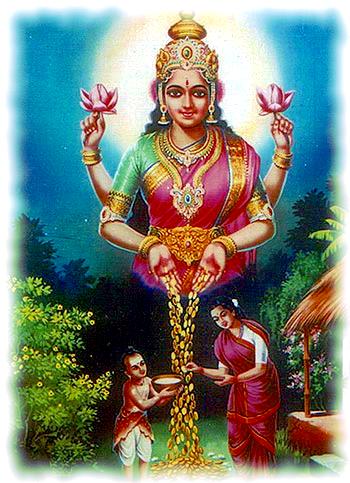
Goddess MahaLakshmi

Birth of Kanakadhara stotram :

Adi Sankara was one of the greatest philosophers of all time. He was born in a poor Brahmin family in Kerala. After brahmopadesa, as is usual during those times, he was asked to beg alms for his lunch. One day when he went to a Brahmin house, the lady of the house was so poor that she did not have anything to give him. She searched hard and found one small fruit of gooseberry, which she gave to Sankara, the boy. He was so touched by her gesture that he sang these 21 mellifluous hymns on Goddess Lakshmi, who poured golden goose berries as rain to the poor woman’s house. Even today it is believed that poverty would be banished by singing this hymn.

Sloka-1 Angam hare pulaka bhooshanamasrayanthi,
Bhringanga neva mukulabharanam thamalam,
Angikrithakhila vibhuthirapanga leela,
Mangalyadasthu mama mangala devathaya.

To the Hari who wears supreme happiness as Ornament,
The Goddess Lakshmi is attracted,
Like the black bees getting attracted,
To the unopened buds of black Tamala[1] tree,
Let her who is the Goddess of all good things,
Grant me a glance that will bring prosperity.

Sloka-2 Mugdha muhurvidhadhadathi vadhane Murare,
Premathrapapranihithani gathagathani,
Mala dhrishotmadhukareeva maheth pale ya,
Sa ne sriyam dhisathu sagarasambhavaya.

Again and again return ,those glances,
Filled with hesitation and love,
Of her who is born to the ocean of milk,
To the face of Murari[2],
Like the honey bees to the pretty blue lotus,
And let those glances shower me with wealth.

Sloka-3 Ameelithaksha madhigamya mudha Mukundam
Anandakandamanimeshamananga thanthram,
Akekara stiththa kaninika pashma nethram,
Bhoothyai bhavenmama bhjangasayananganaya.

With half closed eyes stares she on Mukunda[3],
Filled with happiness , shyness and the science of love,
On the ecstasy filled face with closed eyes of her Lord,
And let her , who is the wife of Him who sleeps on the snake,
Shower me with wealth.

Sloka-4 Bahwanthare madhujitha srithakausthube ya,
Haravaleeva nari neela mayi vibhathi,
Kamapradha bhagavatho api kadaksha mala,
Kalyanamavahathu me kamalalayaya

He who has won over Madhu[4],
Wears the Kousthuba[5] as ornament,
And also the garland of glances, of blue Indraneela[6],
Filled with love to protect and grant wishes to Him,
Of her who lives on the lotus,
And let those also fall on me,
And grant me all that is good..

Sloka-5 Kalambudhaalithorasi kaida bhare,
Dharaadhare sphurathi yaa thadinganeva,
Mathu samastha jagatham mahaneeya murthy,
Badrani me dhisathu bhargava nandanaya

Like the streak of lightning in black dark cloud,
She is shining on the dark , broad chest,
Of He who killed Kaidaba[7],
And let the eyes of the great mother of all universe,
Who is the daughter of Sage Bharghava[8],
Fallon me lightly and bring me prosperity.

Sloka-6 Praptham padam pradhamatha khalu yat prabhavath,
Mangalyabhaji madhu madhini manamathena,
Mayyapadetha mathara meekshanardham,
Manthalasam cha makaralaya kanyakaya.

The God of love could only reach ,
The killer of Madhu[9],
Through the power of her kind glances,
Loaded with love and blessing
And let that side glance ,
Which is auspicious and indolent,
Fall on me.

Sloka-7 Viswamarendra padhavee bramadhana dhaksham,
Ananda hethu radhikam madhu vishwoapi,
Eshanna sheedhathu mayi kshanameekshanartham,
Indhivarodhara sahodharamidhiraya

Capable of making one as king of Devas in this world,
Her side long glance of a moment,
Made Indra[10] regain his kingdom,
And is making Him who killed Madhu [11] supremely happy.
And let her with her blue lotus eyes glance me a little.

Sloka-8 Ishta visishtamathayopi yaya dhayardhra,
Dhrishtya thravishta papadam sulabham labhanthe,
Hrishtim prahrushta kamlodhara deepthirishtam,
Pushtim krishishta mama pushkravishtaraya.

To her devotees and those who are great,
Grants she a place in heaven which is difficult to attain,
Just by a glance of her compassion filled eyes,
Let her sparkling eyes which are like the fully opened lotus,
Fall on me and grant me all my desires.

Sloka-9 Dhadyaddhayanupavanopi dravinambhudaraam,
Asminna kinchina vihanga sisou vishanne,
Dhushkaramagarmmapaneeya chiraya dhooram,
Narayana pranayinee nayanambhuvaha.

Please send your mercy which is like wind,
And shower the rain of wealth on this parched land,,
And quench the thirst of this little chataka[12] bird,
And likewise ,drive away afar my load of sins,
Oh, darling of Narayana[13],
By the glance from your cloud like dark eyes.

Sloka-10 Gheerdhevathethi garuda dwaja sundarithi,
Sakambhareethi sasi shekara vallebhethi,
Srishti sthithi pralaya kelishu samsthitha ya,
Thasyai namas thribhvanai ka guros tharunyai.

She is the goddess of Knowledge,
She is the darling of Him who has Garuda[14] as flag,
She is the power that causes of death at time of deluge,
And she is the wife of Him who has the crescent,
And she does the creation , upkeep and destruction at various times,
And my salutations to this lady who is worshipped by all the three worlds.

Sloka-11 Sruthyai namosthu shubha karma phala prasoothyai,
Rathyai namosthu ramaneeya gunarnavayai,
Shakthyai namosthu satha pathra nikethanayai,
Pushtayi namosthu purushotthama vallabhayai.

Salutations to you as Vedas[15] which give rise to good actions,
Salutation to you as Rathi[16] for giving the most beautiful qualities,
Salutation to you as Shakthi[17] ,who lives in the hundred petalled lotus,
And salutations to you who is Goddess of plenty,
And is the consort of Purushottama[18].

Sloka-12 Namosthu naleekha nibhananai,
Namosthu dhugdhogdhadhi janma bhoomayai,
Namosthu somamrutha sodharayai,
Namosthu narayana vallabhayai.

Salutations to her who is as pretty.
As the lotus in full bloom,
Salutations to her who is born from ocean of milk,
Salutations to the sister of nectar and the moon,
Salutations to the consort of Narayana.

Sloka-13 Namosthu hemambhuja peetikayai,
Namosthu bhoo mandala nayikayai,
Namosthu devathi dhaya prayai,
Namosthu Sarngayudha vallabhayai.

Salutations to her who has the golden lotus as seat,
Salutations to her who is the leader of the universe,
Salutations to her who showers mercy on devas,
And salutations to the consort of Him who has the bow called Saranga.

Sloka-14 Namosthu devyai bhrugu nandanayai,
Namosthu vishnorurasi sthithayai,
Namosthu lakshmyai kamalalayai,
Namosthu dhamodhra vallabhayai.

Salutations to her who is daughter of Bhrigu[19],
Salutations to her lives on the holy chest of Vishnu,
Salutations to Goddess Lakshmi who lives in a lotus,
And saluations to her who is the consort of Damodhara[20].

Sloka-15 Namosthu Kanthyai kamalekshanayai,
Namosthu bhoothyai bhuvanaprasoothyai,
Namosthu devadhibhir archithayai,
Namosthu nandhathmaja vallabhayai.

Salutations to her who is light living in Lotus flower,
Salutations to her who is the earth and also mother of earth,
Salutations to her who is worshipped by Devas,
And salutations to her who is the consort of the son of Nanda[21].

Sloka-16 Sampath karaani sakalendriya nandanani,
Samrajya dhana vibhavani saroruhakshi,
Twad vandanani dhuritha haranodhythani,
Mamev matharanisam kalayanthu manye.

Giver of wealth, giver of pleasures to all senses,
Giver of the right to rule kingdoms,
She who has lotus like eyes,
She to whom Salutations remove all miseries fast,
And my mother to you are my salutations.

Sloka-17 Yath Kadaksha samupasana vidhi,
Sevakasya sakalartha sapadha,
Santhanodhi vachananga manasai,
Twaam murari hridayeswareem bhaje

He who worships your sidelong glances,
Is blessed by all known wealth and prosperity,
And so my salutations by word, thought and deed,
To the queen of the heart of my Lord Murari[22].

Sloka-18 Sarasija nilaye saroja hasthe,
Dhavalathamamsuka gandha maya shobhe,
Bhagavathi hari vallabhe manogne,
Tribhuvana bhoothikari praseeda mahye

She who sits on the Lotus,
She who has lotus in her hands,
She who is dressed in dazzling white,
She who shines in garlands and sandal paste,
The Goddess who is the consort of Hari,
She who gladdens the mind,
And she who confers prosperity on the three worlds,
Be pleased to show compassion to me.

Sloka-19 Dhiggasthibhi kanaka kumbha mukha vasrushta,
Sarvahini vimala charu jalaapluthangim,
Prathar namami jagathaam janani masesha,
Lokadhinatha grahini mamrithabhi puthreem.

Those eight elephants from all the diverse directions,
Pour from out from golden vessels,
The water from the Ganga[23] which flows in heaven,
For your holy purifying bath,
And my salutations in the morn to you ,
Who is the mother of all worlds,
Who is the house wife of the Lord of the worlds,
And who is the daughter of the ocean which gave nectar[24].

Sloka-20 Kamale Kamalaksha vallabhe twam,
Karuna poora tharingithaira pangai,
Avalokaya mamakinchananam,
Prathamam pathamakrithrimam dhyaya

She who is the Lotus,
She who is the consort,
Of the Lord with Lotus like eyes,
She who has glances filled with mercy,
Please turn your glance on me,
Who is the poorest among the poor,
And first make me the vessel ,
To receive your pity and compassion.

Sloka-21 Sthuvanthi ye sthuthibhirameeranwaham,
Thrayeemayim thribhuvanamatharam ramam,
Gunadhika guruthara bhagya bhagina,
Bhavanthi the bhuvi budha bhavithasayo
.

He who recites these prayers daily,
On her who is personification of Vedas,
On her who is the mother of the three worlds,
On her who is Goddess Rema[25],
Will be blessed without doubt,
With all good graceful qualities,
With all the great fortunes that one can get,
And would live in the world,
With great recognition from even the learned.

Translated by P. R. Ramachander

[1] A forest tree
[2] The God who killed the asura called Mura i.e Lord Vishnu
[3] He who gives immortal bliss
[4] An Asura
[5] A garland wirn by Vishnu
[6] A precious blue stone
[7] An Asura
[8] One sage who did penance to have goddess Lakshmi as his daughter and succeeded.
[9] An asura
[10] King of Devas
[11] An Asura
[12] A mythical bird which is always thirsty.
[13] Name of Lord Vishnu
[14] A mythical eagle on which Lord Vishnu travels
[15] Holy books of Hindus
[16] Wife of the God of Love
[17] Goddess parvathy
[18] Greatest among men , a name of Lord Vishnu
[19] Another name for sage Bharghava referred earlier.
[20] He who was tied by a rope in the stomach –a name of Lord Krishna.
[21] Nanda Gopa the foster father of Lord Krishna
[22] He who killed the asura called Mura
[23] The holiest river for Hindus
[24] Goddess Lakshmi was supposed to have come out of the ocean of milk during churning .Nectar along with many things also came out similarly.
[25] A name of Goddess Lakshmi 

Sri Laxmi Narayan Mantra

Sri Lord Narayana and Goddess Lakshmi

"Om Hreeng Hreeng Shreeng Shreeng Laxminarayanay Namah"

This Mantra is highly beneficial for acquiring financial prosperity and materialistic success. It should be recited 10 lakh times for its Siddhi.

Narayanaya Gayatri Mantra

Lord Narayana


Narayana Gayatri Mantra
 
Om Narayanaya Vidhmahe
Vasudevaya Dheemahe
Tanno Vishnu Prachodayaath
 Vishnu is one of the three main gods of the Hindu trimurti (three forms). The trimurti is often depicted in art as one man with three heads. Brahma is the Creator. Vishnu is the Preserver. Shiva is the Destroyer.

The name Vishnu comes from the Sanskrit root 'vish', meaning to pervade. Some Hindu legends describe Vishnu as an eternal deity, and associate him with the primeval waters that pervaded the world before creation. Another name for Vishnu is Narayana, meaning 'one who moves waters'.

To understand Vishnu's role as Preserver, one must accept two basic Hindu beliefs. The first is that humans may escape the cycle of samsara by following predetermined paths of duty. The second is that good and evil are in constant contention for their reign over the world.

It is believed that whenever evil outweighs good with an opportunity to emerge victorious, Vishnu descends to earth in some mortal form to save humanity. Vishnu is not allowed to tamper with events directly. Rather, he intervenes and guides humans to act in ways that will restore proper balance between good and evil.

The puranas speak of the ten avataars of Vishnu. These incarnations detail the divine help given by Vishnu during various stages of human evolution, by appearing on earth in different forms. These avatars are said to demonstrate that divinity re-establishes Dharma or righteousness and destroys injustice from time to time, by appearing on earth in various incarnations.

The ten avataras are Matsyavatara (fish), Koorma (tortoise), Varaaha (boar), Narasimha (the man lion), Vaamana (the dwarf), Parasurama (the angry man), Rama (the perfect human), Balarama and Krishna (the divine statesman). The 10th avatar which is yet to appear is Kalki.

Matsyavatara, or the form of the fish was taken up by Vishnu during a deluge that submerged the earth. Vishnu commanded a rishi to gather together samples of all species and wait in a boat. The gigantic golden fish then dragged the boat through the deluge and then enabled Bhrama to start the act of creation all over again. Yet another legend has it that a demon once stole the four Vedas and hid them under the sea. Vishnu assumed the Matsya form and retrieved them and then restored them to their original fragrance. This legend is held at the Parimalaranganathar temple at Mayiladuturai, near Thanjavur (Tamilnadu).

The Koorma Avatara where Vishnu took the form of a tortoise, is described in the legend of the celestial nectar Amrita.

Vishnu took the form of a wild boar - the Varaaha Avatara, dived into the ocean, and saved Bhoomi Devi who sank into the bottom of the ocean, with his massive snout. Vishnu as Varahamurthy is enshrined at Tiruvidandai near Chennai, and at the Kanchipuram Kamakshiamman temple.

In his Narasimhaavataaram, Vishnu destroyed the demon king Hiranyakashipu and demonstrated his omnipresence in a powerful way.

Vishnu took the form of Vamana the midget to destroy the demon Bali. He visited Bali during a sacrifice where the latter was arrogantly distributing gifts of the seeker's choice, to show his power of wealth. Vamana meekly asked for three feet of land measured by his small feet. All on a sudden he assumed the massive form of Trivikrama, dominating the universe; with his first foot he covered the earth, with the second the heavens. When there was no room for the third, Bali, who never went back on his word offered his head, and Vishnu sent him to the netherworld. Trivikrama is enshrined at Tirukkovilur, Kanchipuram and Sirkazhi in Tamilnadu.

Vishnu then took up the form of Parasurama, to quell the arrogance of the Kshatriya rulers who harmed the sages and unprotected mortals.

The Ramayana speaks of the glory of the Rama Avatar, and the Mahabharata speaks of Balarama and Krishna.

Some schools of thought believe that Krishna was the eighth incarnation of Vishnu and the ninth was Buddha and that Vishnu took up the avataar of Buddha to purify Hinduism of excessive ritualism. He preached detachment, and the middle path consisting of eight fold virtues of right views, right resolve, right speech, right conduct, right livelihood, right effort, right mindfullness and right meditation.

It is believed that at the end of the current epoch, there will be a deluge when Kalki - the tenth and the last avatara of Vishnu, will ride forth on a horse to redeem humankind and re-establish righteousness.

There is a legend for each one of Vishnu's first nine avatars and how each one intervened to preserve the universally required balance of good and evil. Vishnu's tenth avatar, Kalki, the horseman, has not yet descended to earth. It is believed that his arrival will mark the end of this present age of evil, known as the Kali Yuga.

Vishnu often appears dressed in yellow robes, hence his name Pitambara, or the yellow-vested one. Although his traditional vehicle is a giant mythical bird called Garuda, Vishnu may also be depicted amid the cosmic waters, reclining on the back of the coiled serpent named Sesha.

If Vishnu is depicted as reclining on the back of Sesha, this is a sign that order is prevailing in the cosmos, and a proper balance between good and evil is being maintained throughout the universe. If Vishnu is depicted as riding or standing near Garuda, this is a sign that he is ready to descend to earth and interact with mortals to preserve cosmic order.

Vishnu's wife is Lakshmi, goddess of fortune, wealth, and prosperity. She is often depicted together with Vishnu, seated on Garuda.

Vishnu is a popular deity and is worshipped widely throughout India. He has 1,000 names, and devotees who engage in his name recitation and repetition are believed to accumulate great blessings.

Moola Mantra

Ashta Lakshmi

  Moola Mantra

Om Shrim Mahalakshmiyei Swaha
 
Almighty Lord Sri Narayana or Mahavishnu is known for looking after the welfare and well being of the phenomenal world or the creation. The power or energy of Sri Narayana is Sri Lakshmi. Mother Lakshmi is always identified with the Lord, and hence they are known as Sri Lakshmi Narayana. Mother Lakshmi is a mother of prosperity, peace and illumination. Without Her grace one can´t have inner peace or perennial joy.


Lakshmi is commonly known as Goddess of wealth. Wealth is not only the money. Tradition and values of life is also wealth. Our family and progress is also wealth. Our belongings such as land, properties, animals, grains, etc as well as virtues like patience, persistence, purity etc in the form of a character are nothing but our wealth and so also glory or victory. Thus this eightfold Sri Lakshmi is known as Sri Ashta Lakshmi.


Mother Lakshmi is the source and provider of the following enumerated well-known sixteen types of wealth and many more. (1) Fame (2) Knowledge (3) Courage and Strength (4) Victory (5) Good Children (6) Valour (7) Gold and other gross properties (8) Grains in abundance (9) Happiness (10) Bliss (11) Intelligence (12) Beauty (13) Higher Aim, High Thinking and Higher Meditation too (14) Morality and Ethics (15) Good Health (16) Long Life. Let us glance upon the glory of mother Ashta Lakshmi´s individual nature and forms.


Adi Lakshmi: Mother Lakshmi resides with Lord Narayana in the Vaikuntha, the abode of Lord Narayana. She is known as Ramaa, means bringing happiness to the mankind. She is also known as Indira (who holds lotus or purity in the hands or heart.) Divine Mother´s this form is normally seen serving Sri Narayana. Lord Narayana is omnipresent. Adi Lakshmi or Ramaa Lakshmi serves Sri Narayana is symbolic of her serving the whole creation. Though Sri Narayana is attended by innumerable devotees, still she personally loves to serve the Lord. Actually mother Adi Lakshmi and Narayana are not two different entities but one only. Many a place we see her form sitting in the lap of Sri Narayana.


Dhanya Lakshmi: Dhanya means grains. This includes all kind of purified food containing all essential vitamins, minerals, protein, calcium, carbohytrade and so on. With the grace of mother Dhanya Lakshmi one gets all essential nutrients grains, fruits, vegetables and other foods.


Dhairya Lakshmi: This form of mother Lakshmi grants the boon of infinite courage and strength. Those, who are in tune with infinite inner power, are always bound to have victory. Those who worship mother Dhairya Lakshmi they live and lead a life with tremendous patience and inner stability.


Gaja Lakshmi: In the holy book of Srimad Bhagavata the story of the churning of the ocean by Gods and demons is explained in detail. Author, the Sage Vyasa writes that Lakshmi came out of the ocean during the churning of the ocean (Samudra Manthan). So she is known as a daughter of the ocean. She came out of the ocean sitting on a full-bloomed lotus and also having lotus flowers in both hands with two elephants by her sides, holding a beautiful vessels filled with milk and pouring it over Sri Lakshmi. Many a time we see Sri Lakshmi standing in the lotus and elephants are pouring nectar over her. During the festival of the lamps or the Deepavali along with Sri Lakshmi the Ganapati or the Elephant God also gets worshipped; that signifies the protection from evils as well as abundant grace and blessings for additional prosperities!


Santan Lakshmi: In the family life, the children are the greatest treasure. Those who worship this particular form of Sri Lakshmi, known as a Santan Lakshmi, are bestowed with the grace of mother Lakshmi and have wealth in the form of desirable children with good health & long life.


Vijay Lakshmi: Vijay is victory. Vijay is to get success in all undertakings and all different facets of life. Some are strong physically but weak mentally while others are economically rich but poor in their attitude and cannot exert any influence. Vijay is to have all encompassing victory. Vijay is to rejoice glory of our real nature - Vijay is to conquer the lower nature. Vijay is the victory in external and internal wars and of course eternal wars! Hence those, with grace of mother Vijay Lakshmi, have victory everywhere, at all time, in all conditions. Victory to Vijay Lakshmi !!


Dhana Lakshmi: Dhana is wealth. But as per Rigved´s Purush Shukta Dhana is not only a wealth in coins and currency. Even Sun and moon, fire and stars, rains and nature, oceans and mountains, rivers and streams, all these are our wealth, so are the progeny, our inner will power, our character and our virtues. With the grace of mother Dhana Lakshmi we will get all these in abundance.


Vidya Lakshmi: Vidya is education. Education is not mere studies to receive the degrees and diplomas certificates from the educational institutes or universities. Rev. Sri Gurudev Swami Sivanandaji Maharaj says:
Serenity, Regularity, Absence of Vanity, Sincerity, Simplicity, Veracity, Equanimity, Fixity, Non-irritability, Adaptability Humility, Tenacity, Integrity, Nobility, Magnanimity, Charity, Generosity and Purity are the eighteen "itis" that only can give immortality.

Education, which cannot give peace to the soul or cannot give the knowledge of the Self and the inner satisfaction, is not education. Education, which cannot wipe the tears of others, known or unknown, is not education. Education is the understanding the situation and silence or art of living and leading the life that can make the life, the Life Divine, where the ultimate Goal of the life is the God-Realisation.

Such Education can come only through discrimination and dispassion. One can have abundant amount of money, but if he does not know how to make good use of it, it will work to his disadvantage. If an alcoholic or a drug addict gets a big sum of money, it will only hasten his downward journey to destruction. Vidya Lakshmi is the understanding and the knowledge to mold the ordinary life into the Divine Life. A life of Service, a life of feeling for a fellow being, a life of charity and generosity, a life of purity, a life for seeking a soul within the soul and a life with an ultimate aim of the realisation of the ABSOLUTE is the only real education, which can come only with the grace of Vidya Lakshmi.

Thus all these eightfold Sri Lakshmi is ultimately one single power only. That is Adishakti.

The perennial and unchangeable, ever lasting, eternal truth or the absolute is this Supreme blessedness, the mother Adishakti. She is the origin. She is the light. She is the power, the wisdom and the strength. She is the Supreme Joy, peace, bliss and illumination.

Year after year We have seen the lamps being lit for Diwali, the birth day and the wedding day of Goddess Lakshmi. In the dark night the glowing flames herald the advent of longer nights-the early days of an Indian winter.

The essence of this light is Shri Lakshmi-arising, at the beginning of time, out of the waters at the churning of the Milky Ocean by gods and demons for a thousand years. Regarded as the goddess of love, beauty and prosperity, Lakshmi, Kamla or Padma (Sanskrit words for lotus), the beloved consort of Vishnu, along with the dearly loved pot-bellied, elephant headed, auspicious god of the Hindu theogony, Siri Ganesha, is a presiding deity of the festival of lights. They are worshipped in every household so that the year may be full of prosperity. Throughout the night a lamp is kept burning before her image so that she may continue to dwell in the house and bestow upon it the wealth of life.

May Mother Adishakti´s and Sri Ashta Lakshmi´s grace be ever upon we all, to receive Her divine grace for being befitting servant of the mankind in Her cosmic kingdom. Om Shanti.

108 Names of Shri Shirdi Sai Baba


The Garland of One Hundred and Eight Names of the Venerable Shirdi Sai

1. Om Srii Saaii naathaaya Namah.Om, to the Venerable Lord Sai, prostration !
2. Om Laksmiinaaraayanaay a Namah.Om, to (Vishnu as the Sleeping God lying on waters in the interval between destruction and re-manifestation of universes) Narayana (accompanied by the Goddess of Wealth)L akshmi, prostration !
3. Om Krishna-Raama- Shiva-Maaruty' aadi-ruupaaya Namah.Om, to Him whose forms Krishna and Rama, Hanuman the son of wind and so on are, prostration !
4. Om Sheshashaayine Namah.Om, to Vishnu (in his aforementionned form) laying on Shesha (Divine Serpent), prostration !
5. Om Godaavarii-tata- shiiladhii- vaasiine Namah.Om, to who has His abode near the shores of(the Holy river) Godavari, prostration!
6. Om Bhakta-hridaalayaay a Namah.Om, to Him whose seat (His) devotees' hearts are, prostration!
7. Om Sarva-hrinnilayaaya Namah.Om, to Him whose abode the hearts of all (beings) are, prostration!
8. Om Bhuutaavaasaaya Namah.Om, to Him in whom the beings dwell, prostration!
9. Om Bhuuta bhavishyad-bhaava- varjitaaya Namah.Om, to Him who is bereft of past, future and present, prostration!
10. Om Kaalaatiitaaya Namah.Om, to Him who transcends time (and death) prostration !
11. Om Kaalaaya Namah.Om, to (Krishna in his cosmic aspect shown to Arjuna in the Bhagavadgita) who is Time, prostration !
12. Om Kaalakaalaaya Namah.Om, to (Shiva as Savior of His devotee Markandeya menaced by Yama) the Death of Time, prostration !
13. Om Kaala-darpa- damanaaya Namah.Om, to (Shiva in His aforementionned form) the Subduer of the pride of Time, prostration !
14. Om Mrityunjayaaya Namah.Om, to (Shiva in His aforementionned form) the Death-winner, prostration !
15. Om Amartyaaya Namah.Om, to the Deathless One, prostration !
16. Om Martyaabhaya- pradaaya Namah.Om, to Him who gives mortals immortality, prostration !
17. Om Jeevaadhaaraaya Namah.Om, to Him who sustains the living (beings), prostration !
18. Om Sarvaadhaaraaya Namah.Om, to Him sustains all, prostration !
19. Om Bhaktaavana- samarthaaya Namah.Om, to Him who has the power to protect His devotees, prostration !
20. Om Bhaktaavana- pratijnaaya Namah.Om, to Him who promises to grant favors to (His) devotees, prostration !
21. Om Anna-vastra- daaya Namah.Om, to Him who grants food and clothing, prostration !
22. Om Arogya-kshema- daaya Namah.Om, to Him who grants health and patience, prostration !
23. Om Dhana-maangalya- pradaaya Namah.Om, to Him who freely gives wealth and fortune, prostration !
24. Om Riddhi-siddhi- daaya Namah.Om, to Him who grants (yogic)powers and realization, prostration !
25. Om Putra-mitra- kalatra-bandhu- daaya Namah.Om, to Him who grants sons, friends, wives and kin, prostration !
26. Om Yoga-kshema- vahaaya Namah.Om, to Him who brings forth yogic accomplishment, prostration !
27. Om Aapad-baandhavaaya Namah.Om, to Him who washes away misfortunes, prostration !
28. Om Maarga-bandhave Namah.Om, to (Shiva as sung in a celebrated hymn by the mystic, philospher, and literate Appayya Dikshita) the Friend along the path, prostration !
29. Om Bhukti-mukti- swargaapavarga- daaya Namah.Om, to Him who grants fruitions, liberation, heaven and abandonment of rebirth, prostration !
30. Om Priyaaya Namah.Om, to the Beloved One, prostration !
31. Om Priiti-vardhanaaya Namah.Om, to Him who increases love, prostration !
32. Om Antaryaamine Namah.Om, to (the Absolute as Paramatman, the Supreme Self) the Inner Ruler, prostration !
33. Om Saccidaatmane Namah.Om, to (Paramatman) who self Being and Consciousness are, prostration !
34. Om Nityaanandaaya Namah.Om, to (Paramatman) who is Eternal Bliss, prostration !
35. Om Parama-sukha- daaya Namah.Om, to Him who grants supreme ease, prostration !
36. Om Parameshvaraaya Namah.Om, to (Paramatman) the Supreme Lord, prostration !
37. Om Parabrahmane Namah.Om, to (Paramatman) the Supreme Brahman, prostration !
38. Om Paramaatmane Namah.Om, to the Supreme Self, prostration !
39. Om Jnaana-svaruupine Namah.Om, to (Paramatman) whose nature very nature gnosis is, prostration !
40. Om Jagatah pitre Namah.Om, to (Brahma) the Father of the universe, prostration !
41. Om Bhaktaanaam maatri dhatri pitaamahaaya Namah.Om, to (Brahma) who is a mother for (His) devotees, the Bearer (of universe) and the Great Sire, prostration !
42. Om Bhaktaabhaya- pradaaya Namah.Om, to Him who freely gives to (His) devotees fearlessness, prostration !
43. Om Bhakta-paraadiinaay a Namah.Om, to Him who cares for (His) devotees, prostration !
44. Om Bhaktaanugraha- kaataraaya Namah.Om, to Him who is very gracious to (His) devotees, prostration !
45. Om Sharanaagata- vatsalaaya Namah.Om, to Him who loves those who seek refuge (in Him), prostration !
46. Om Bhakti-shakti- pradaaya Namah.Om, to Him who freely gives devotion and power, prostration !
47. Om Jnaana-vairaagya- daaya Namah.Om, to Him who grants gnosis and detachment, prostration !
48. Om Prema-pradaaya Namah.Om, to Him who freely gives love, prostration !
49. Om Samshaya-hridaya- daurbalya- paapakarma- vaasanaa- kshaya-karaaya Namah.Om, to Him who causes obliteration of doubts, heart feebleness, sins, karman( of present and past lives) and the traces (thereof), prostration !
50. Om Hridaya-granthi- bhedakaaya Namah.Om, to Him who cuts off the heart knot (Upanishadic metaphor for ultimate realization) , prostration !
51. Om Karma-dhvamsine Namah.Om, to the Destroyer of karman (of present and past lives), prostration !
52. Om Shuddha-sattvasthit aaya Namah.Om, to Him who stays in pure minds, prostration !
53. Om Gunaatiita-gunaatma ne Namah.Om, to (paramatman) who transcents attributes and (yet) is the very self of attributes, prostration !
54. Om Ananta-kalyaana- gunaaya Namah.Om, to (Vishnu as worshipped by the Pancaratra tradition) who is possessed of infinite auspicious attributes, prostration !
55. Om Amita-paraakramaaya Namah.Om, to Him whose strength is unmeasureable, prostration !
56. Om Jayine Namah.Om, to the Conqueror, prostration !
57. Om Durdharsha kshobhyaaya Namah.Om, to the Unconquerable and Unshakable One, prostration !
58. Om Aparaajitaaya Namah.Om, to the Invincible One, prostration !
59. Om Trilokeshu avighaatha-gataye Namah.Om, to (Vishnu in His descent in the world as the Brahmin dwarf, Vamana) whose going in unimpeded in the three worlds (earth, intermediate space, and heaven), prostration !
60. Om Ashakya-rahitaaya Namah.Om, to Him for whom nothing is impossible, prostration !
61. Om Sarva-shakti- muurtaye Namah.Om, to Him who is All-Powerful, prostration !
62. Om Suruupa-sundaraaya Namah.Om, to the Handsome and Beautiful One, prostration !
63. Om Sulocanaaya Namah.Om, to Him with beautiful eyes, prostration !
64. Om Bahu ruupa vishva muurtaye Namah.Om, to Him of many shapes, having all forms, prostration !
65. Om Aruupaavyaktaaya Namah.Om, to (Paramatman) the Formless and Unmanifest One, prostration !
66. Om Acintyaaya Namah.Om, to (Paramatman) the Unthinkabale One, prostration !
67. Om Suukshmaaya Namah.Om, to (Paramatman) the Subtle One, prostration !
68. Om Sarvaantaryaamine Namah.Om, to (Paramatman) who is everybody's Inner Ruler, prostration !
69. Om Manovaagatiitaaya Namah.Om, to (Paramatman) who transcends mind and speech, prostration !
70. Om Prema-muurtaye Namah.Om, to Him whose face Love (as the ultimate mystic experience) is, prostration !
71. Om Sulabha-durlabhaaya Namah.Om, to Him easy to reach (yet) difficult to approach, prostration !
72. Om Asahaaya sahaayaaya Namah.Om, the Helper of the Helpless, prostration !
73. Om Anaathanaatha- diina-bandhave Namah.Om, to the Protector of those without protector, the Friend of the poor, prostration !
74. Om Sarva-bhaara- bhrite Namah.Om, to Him who takes upon Himself everyone's burden, prostration !
75. Om Akarmaaneka- karma-sukarmine Namah.Om, to Him who well accomplishes the unsavory tasks, prostration !
76 Om Punya-shravana- kiirtanaaya Namah.Om, to Him the hearing of whose glorification is purifying, prostration !
77 Om Tiirthaaya Namah.Om, to the (holy) Ford, prostration !
78 Om Vaasudevaaya Namah.Om, to (Krishna) Vasudeva's Son, prostration !
79. Om Sataangataye Namah.Om, to the Ultimate Resort of the good, prostration !
80. Om Satparaayanaaya Namah.Om, to the Final End of the good, prostration !
81. Om Lokanaathaaya Namah.Om, to the Lord of the worlds, prostration !
82 Om Paavanaanaghaaya Namah.Om, to the Purifier Immaculate, prostration !
83. Om Amritaamshave Namah.Om, to (the Moon identified with Holy Plant Soma) whose filaments give forth the juice of immortality, prostration !
84. Om Bhaaskara-prabhaaya Namah.Om, to the Sun of shining halo, prostration !
85. Om Brahmacarya- tapascaryaadi- suvrataaya Namah.Om, to Him whose vows are chastity, asceticism and so on, prostration !
86. Om Satya-dharma- paraayanaaya Namah.Om, to Him who is the ultimate resort of truthfulness, prostration !
87. Om Siddheshvaraaya Namah.Om, to Shiva of Yogic powers, prostration !
88 Om Siddha-sankalpaaya- Namah.Om, to the Lord of the Realized Ones (the immortal yogin Dattatreya), prostration !
89. Om Yogeshvaraaya Namah.Om, to (Shiva) the Lord of Yoga, prostration !
90. Om Bhagavate Namah.Om, to the Possessor of Divine Glory, prostration !
91. Om Bhakta-vatsalaaya Namah.Om, to Him who loves His devotees, prostration !
92. Om Satpurushaaya Namah.Om, to the True Male (purusa), prostration !
93. Om Purushottamaaya Namah.Om, to the Best among Men, prostration !
94. Om Satya-tattva- bodhakaaya Namah.Om, to (the Guru) who awakens (His disciples) to the Principles of Reality, prostration !
95. Om Kaamaadi-shad- vairi-dhvamsine Namah.Om, to the Destroyer of the Six Foes beginning with Desire (Desire, Anger, Greed, Hatred, Pride, and Envy), prostration !
96 Om Abhed-aanandaanubha va-pradaaya Namah.Om, to Him who freely gives the actual experience of Undivided Bliss, prostration !
97. Om Sama-sarva-mata- sammataaya Namah.Om, to (the Sai himself, here presented in a characteristic feature of His teaching) who approves all religious persuasions as equal, prostration !
98. Om Shrii dakshinaa-muurtaye Namah.Om, to the Venerable (Shiva as the Teacher of Absolute Truth through silence) with His face to the South(the direction of Death, as identified with one of the Fires in the Vedic sacrifice), prostration !
99. Om Shrii venkatesha ramanaaya Namah.Om, to Ramana, the Lord of Venkata Hill, prostration !
100. Om Adbhutaananta- caryaaya Namah.Om, to Him of wonderful and blissful deeds, prostration !
101. Om Prapannaarti- haraaya Namah.Om, to Him who takes away the pains of those who yield themselves (to Him), prostration !
102. Om Samsaara-sarva- duhkha-kshaya- karaaya Namah.Om, to the Cause of the obliteration of every suffering of the Round of Rebirth, prostration !
103. Om Sarvavit-sarvato- mukhaaya Namah.Om, to the Omniscient One, whose face is turned everywhere, prostration !
104. Om Sarvaantar-bahih- sthitaaya Namah.Om, to Him who stays inside and outside all(beings), prostration !
105. Om Sarva-mangala- karaaya Namah.Om, to the Cause of all auspiciousness, prostration !
106. Om Sarvaabhiista- pradaaya Namah.Om, to Him who freely gives all things wished for, prostration !
107. Om Samarasa-sanmaarga- sthaapanaaya Namah.Om, to Him who consolidates the Truth Path along which all experience (for the mystic) has the same taste, prostration !
108. Om Shrii samartha sadguru Saaii naathaaya Namah.Om, to the Venerable Efficacious True Guru, the Lord Sai, prostration !

Gayathri Mantra of Shirdi Sai Baba

Lord Shirdi Sai Baba
Sai Gayathri Mantra

Aum Shirdi Vasaaya Vidmahe
Sachchidhaanandaaya Dhimahee
Thanno Sai Prachodayath

Meaning
We know this Sai is Supreme Divinity incarnate. We meditate on this God of Truth. May this Almighty Personality lead us on the path of total liberation

Best Time to Chant : Thursdays
Number of Times to Chant : 11, 33, 108, or 1008 times

Satvika Tyagam (Atmasamarpan Mantra)

 Surrendering yourself to God
Lord Narayana


Kayena vacha manasendriyairva
Buddhyatmana va prakrite swabhavath
Karomi yadyad sakalam parasmai
Narayanayeti samarpayami


Meaning
Whatever i do with my speech, Whatever I do with my body, Whatever I do with my mind, Whatever I do with my soul or with other senses of my body,  And whatever I do with natures help! I offer (dedicate) everything to Lord Narayana.

Mantra to Recite Before going to Bed


Mantra to be recited before going to bed sleep. 


Mantra:
"Karacharana Krn Itam Vaakkaayajam Karmajam Vaa, 
Shravananayanajam Vaa Maanasam Vaaparaadham,
Vihitamavihitam Vaa Sarvametatkshamasva,
Jaya Jaya Karunaabdhe Shriimahaadeva Shambho" 


Meaning : 
O God, kindly pardon my incorrect actions done consciously or unconsciously, either through my organs of action (hand, feet, and speech) or through my organs of perception (eyes, ears) or by my mind. I adore the God, who is the ocean of kindness.


Mantra to Recite While Lighting Lamp:

Mantra to be recited while lighting lamp 

Mantra:
"Subham Karoti Kalyanam
Arogyam Dhana Sampadah
Shatru Buddhi Vinashaya
Dipa Jyotir Namostute

Meaning: 
The accurate meaning of the mantra is: "I fold my hands before the light that brings prosperity, auspiciousness, good health, abundance of wealth and destruction of the enemy's intellect". Here, Darkness symbolizes enemy's intellect and with the arrival of light, darkness disappears. Likewise, light (God's Grace) destroys darkness (enemy's intellect).

-------------------------------------------------------------------------------------------------------------

Mantra:
"Deepajyothi Parabrahma
Deepajyothi Janardhana
Deepo Me Hara Tu Paapam
Deepaa Jyothir Namostute"

Meaning: 
The literal meaning of the mantra is: "I fold my hands before the lord, the maintainer of this creation, in the form of this light. I adore this light, which destroys all the pains resulting from my omissions and commissions".
----------------------------------------------------------------------------------------------------------------

Mantra:
"Brahmaarpanam brahma havih brahmaagnau brahmanaa hutam
brahmaiva tena gantavyam brahma-karma-samaadhinaa"

Meaning: 
Just like the light from this map, spread happiness, prosperity, health in out lives. Just like you get rid of darness, get rid of our ignorance.

Mantra to recite Before Eating Food


Before eating, you can also say a prayer to Annapurna Devi to dedicate the food to Her.

Mantra:
"Annapurne sadaapurne Shankara praana vallabhe
Gnaana Vairaagya sidhyardham Bikshaamdehi cha Parvati"


Meaning: Hey , Mother annapUrNeswari,beloved shakti of shivA,fullness everlasting and fully manifest as this food,please give me alms,of knowledge, renunciation and spiritual perfection,for me forever.

Mantra to be Recited While Taking bath


Mantra to be recited while taking bath in home or holy bath in rivers etc. 

Mantra:
Gangeycha Yamuneychaiva godhavari saraswathi
Narmadey sindhuh kaveri Jalesmin sannidhim kuru

Meaning: 
The literal meaning of this mantra is: "In this water, I invoke the presence of divine waters from the rivers Ganga, Yamuna, Godavari, Saraswati, Narmada, Sindhu and Kaveri. These rivers are considered as goddesses and I pray to them for considering me for their blessings. 

Significance: 
God has given us a beautiful life to live and has created this beautiful world. There are massive rivers and oceans in it. Many rivers like, Ganga, Yamuna, Saraswati etc have their own significance. Taking bath in these rivers is considered auspicious. So, reciting this Sloka/Mantra with a sincere heart brings you the benefit of taking bath in these rivers.

Gayatri mantra is also a common to say in the morning when taking the first bath, especially at sunrise.

Mantra to recite before placing your foot on land


Bhoodevi (Goddess Lakshmi) - Goddess of Earth


Bhoomi Vandanam Mantra:


Samudravasane devi parvatstanmandale
Vishnupatni namostubhyam padsparsham kshamaswa me
Vishunupati samutpanne shankhavarna-mahitale
Aanek-ratnasampanne bhumidevi namo namah


Significance:
Our life depends on the land, before touching it with the feet, one should apologize to that shakti (Energy Principle). 

Meaning:
I bow to Mother Earth, who has mountains and jungles on her body and whose clothing is made by the ocean. The wife of Lord Vishnu, please pardon me for touching you with my feet.

Mantra to Recite While Getting up from bed

After getting up from the sleep, kardarshan (viewing the palm of the hand) should be done.


Mantra:
Karagre Vasate Lakshmi, Karmadhye Saraswati
Karmule tu Govind, Prabhate kardarshanam


कराग्रे वसते लक्ष्मी, करमध्ये सरस्वती
करमूले तु गोविन्दः, प्रभाते कर दर्शनम्


Meaning:

On the tip of your fingers is Goddess Lakshmi; on the base of your fingers is Goddess Sarasvati; in the middle of your fingers is Lord Govinda. In this manner, look at your palm.

Significance:
Laxmi, Saraswati and Govind reside on the palm, so one should bow to them with respect, this is the logic behind kardarshan. Of course, with common sense point of view, to get hold of Lakshmi (money) and Saraswati (knowledge) is in our hands only, to remind one of this principle is the main logic behind kardarshan.

Sastha or Ayyapan Gayatri Mantra


Lord Ayyapa

Boodha Naathaya Vidmahe
Bhavaputhraaya Dheemahi
Thanno Saastha Prachodayaath.


Meaning in English Translation:
We worship Lord Ayyappa, the son of Siva.
Salutations to Saastha (Ayyappa).
May that Ayyappa stimulate our creative faculties

Mantra to Overcome Bad Times

This Mantra can be recited 108 times a day to Overcome Bad Times

Om Pushkaraakshaaya Namaha


In Telugu
ఓం పుష్కరాక్షాయ నమః  

కష్టాల నుండి విముక్తి పొందడానికి   

Mantra to Keep Evil Forces at Bay

This Mantra can be recited 108 times a day to keep Evil Forces at bay:

Om Sthavishtaya Namha


In Telugu
   ఓం స్థవిష్ఠయ నమః
దుష్ట శక్తుల నుండి కాపాడుకొనుటకు