This year Mahashivratri falls on
03rd March 2011
when the Shiva principle descends to Earth
a thousand times more than usual.
On this day, to obtain the full benefit of
Lord Shiva's principle,
one should chant'Om Namah Shivaya'as much as possible.
Shivratri
is the time when Shiva takes a rest.
Shiva rests for one 'prahar' (three hours) of the night..
This 'prahar' is referred to as the Shivratri.
When Lord Shiva takes rest, the function of
'Shivtatva' (Shiva Principle) ceases,
i.e. Lord Shiva goes into a meditative state.
Shiva's meditative state is the time when
He is engrossed in His own spiritual practice.
During that time,
the 'Shivtatva' does not accept any tamogun
(most base of the 3 elements in us - sattva, raja & tama)
or
any halahal (venom churned from the ocean)
coming from the Universe.
As a result,
the ratio of halahal or the pressure
of the negative energies increases.
For protection from this pressure, things like
'bilva patra', white flowers, 'rudraksha' beads etc
are offered to Lord Shiva.
These things attract the 'Shivtatva' from the atmosphere,
thus providing protection from the increasing
effect of the negative energies.
The Earth is a gross object.
Gross objects have very low velocities
i.e. they require more time to cover a specific distance in space.
Gods on the other hand, are subtle hence they
are capable of traversing space within a few seconds.
That is why one year on the earth
is equivalent to just one day of heaven.
Science in the worship of
Lord Shiva on Mahashivratri
The function of the
'Shivpindi'
1.
Emitting waves of Knowledge,
Devotion and renunciation
Predominantly
'sattva' waves of knowledge,
'raja' waves of devotion
and
'tama' waves of Renunciation (Vairagya)
are emitted by the 'Shivpindi'.
During Mahashivratri,
the emission increases by 30 percent.
2..
Emission of subtle vibrations
of chaitanya, bliss and peace
The 'Shivpindi' emits
subtle vibrations of chaitanya, bliss and peace.
During the Mahashivratri,
the emission increases by 25 percent.
This helps purify the subtle-body of
one who worships the Shivpindi on this day.
The 'sun' or the 'moon' channels
in the body get activated as per necessity.
The capacity to absorb the sattvaguna
and chaitanya also increases.
Due to the presence of the unmanifest
Shiva principle in the Shivpindi
and the vibrations of peace emitted,
the Shivpindi remains cool and the
mind too experiences peace.
Worship of Shivpindi with devotion,
activates the dormant Shiva principle.
An offering of puffed rice and milk
reaches Lord Shiva in the subtle form.
3.
Receiving the
'tarak or marak tatva (element)'
as required
There is a confluence of the manifest
and the unmanifest elements along with the
'tarak and marak tatva' in the Shivpindi.
(Tarak = Saviour; Marak = Destroyer).
That is how worshipers receive the required element.
The temperature of the Shivpindi increases due
to the emission of the marak tatva
and there one experiences bliss.
Similarly,
when the tarak tatva is emitted,
the temperature drops and one experiences peace and bliss.
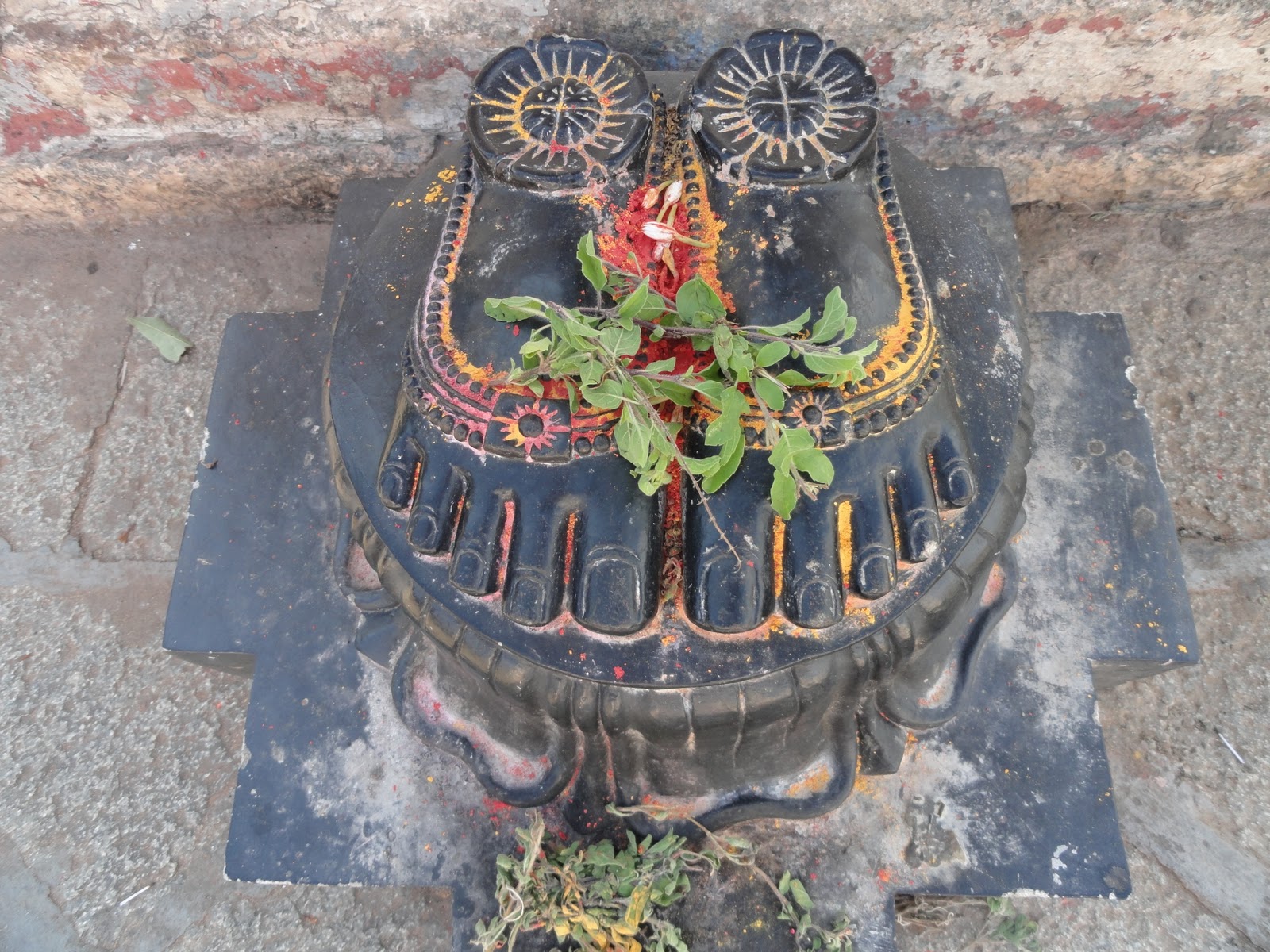
Bilvapatra (Bel leaves)
Bilvapatra contains 2% Shiva tatva.
By offering bilvapatra to the Shivpindi on Mahashivratri,
the manifest Shiva tatva near the stalk of
the bilvapatra gets activated.
Due to this, waves of chaitanya as well as Shiva tatva
are emitted by the bilvapatra.
The bilvapatra
attracts 20% of the Shiva tatva present in
the Shivpindi towards itself.
By immersing this bilvapatra
in water or by placing it in grains,
the Shiva tatva present in the bilvapatra is transmitted to them.
The Shiva tatva in the bilvapatra
is activated to a larger extent on Mondays
when it transmits 10% of the Shiva tatva and sattvikta.
On other days only 1% of the Shiva tatva
is activated in the bilvapatra.
Bilvarchan
Offering bilvapatra
to the Shivpindi and chanting the mantra
'Om Namah Shivaya'
with each offering is known as bilvarchan.
Continue offering the bilvapatra until the pindi
is completely covered.
Offer the bilvapatra from the lower part of the pindi.
By starting from the feet of the idol,
more benefit is derived and the idol
can be covered completely.
Chanting on Mahashivratri
'Om Namah Shivaya'
Om represents an unmanifest state beyond
the 3 gunas (elements of sattva, raja & tama).
We bow to Lord Shiva, from whom Om was created.
What does the word 'Shiva' mean?
a.
The word Shiva has been derived
by reversing the letters of the word vash.
Vash means to enlighten; thus the one
who enlightens is Shiva.
He remains radiant and also illuminates the universe.
b..
He is the auspicious and
prosperity-bestowin g principle.
Some unique attributes
1. Physical attributes
a. Ganga :
Just as the sun is the focal point of the solar system
and the soul that of the body,
the focal point of divine consciousness
(chaitanya) in every object and
pure particles (pavitrakas) is ga-aum.
The flow from which ga-aum originates is gan gaha = Ganga.
Ga-aum flows from Shiva's head.
This is called the descent of the Ganga
from Shiva's head.
Since the river Ganga has a fraction
of the principle of the spiritual Ganga,
no matter how polluted it becomes,
its purity is perpetually retained.
Hence,
when compared to any other water in the world,
the water from the Ganga is the purest.
This is realised not only by those
who can perceive the subtle dimension
but also by scientific researchers.
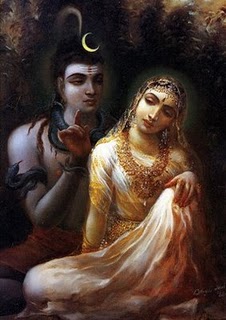
b. Moon :
Shiva adorns the chandra (moon) on His forehead.
The point where the three frequencies
- affection (mamata), mercifulness (kshamashilata)
and motherly love (vatsalya) originate
is referred to as the chandra (moon).
Thus, one can conclude that chandrama
(the moon principle) is the state in
which the three attributes of affection,
mercifulness and motherly love are present.
c. Third eye :
Shankar is three-eyed,
i.e. He can perceive events of the past, present and future.
According to the science of Yoga
the third eye means the Sushumna nadi (channel).
d. Serpent :
One of the Names of Lord Shankar is Bhujanga-patihari.
Bhujang means a serpent or pure particles (pavitrakas) ,
pati means the nurturer and hari means one
with a garland around His neck.
Bhujangapatihari thus means the One
who nurtures pure particles and wears them like a garland.
Various serpents represent groups of pure particles.
Though externally they appear like serpents,
internally they are a kind of ladder.
To make spiritual progress one has to climb
up holding onto the tail of the serpent.
Lord Shankar adorns serpents at nine points on His body
- one on the head,
one around the neck,
one on each arm,
one on each wrist,
one around the waist and
one on each thigh.
This implies that His body is comprised
of pure particles or that serpents of pure particles
play all over the body of Lord Shankar
who has the universe as His form.
2. Spiritual attributes
a.. One performing severe
austerities and the great yogi
Shiva is always seated in a bandha or a mudra.
His temperature rises due to heat generated
by performing severe austerities;
Hence, He uses the Ganga, the moon and
serpents which endow a cooling effect
and lives on the snow-clad Kailas mountain.
b.. Short tempered
If someone disturbs His meditation
the radiance generated by spiritual practice
will be suddenly expelled and whoever is in front of Him
will not be able to tolerate it, and gets destroyed.
This is referred to as being 'reduced to ashes
by Shankar's opening of the third eye'.
c..
One who is willing to undergo
any distress for the sake of imparting happiness to others
The poison
generated during the churning
of the celestial ocean (samudramanthan)
was burning the entire Universe but no deity
came forward to accept it.
At that time Shiva drank that poison
and saved the world from destruction.
d.
One who has both,
deities and demons, as His worshippers
Neither did demons
like Banasur, Ravan, etc.
worship Lord Vishnu nor did Lord Vishnu bestow
any boon upon any demon.
However, they worshipped Lord Shiva who blessed them.
e. Master of the spirits
Since Lord Shiva is the master of spirits,
His worshippers are generally not possessed by them.
Science in the idol - in the Human form
 This represents the Brahman
in the form of the word (shabda Brahman).
Alphabets consisting of the sounds of
fifty-two basic letters and the forms
of fourteen Maheshvar verses (sutras)
have generated from it.
Later the universe was created from these.
2. Trident :
represents the following -
The three components - sattva, raja and tama
The root of creation, sustenance and dissolution
Volition, knowledge and action
3. Noose (pash) :
The noose represents the noose of time (kalpash) (The rope in Lord Ganapati's hand too is the same).
Worship
a. Application of holy ash (Bhasma)
Tripundra refers to the three horizontal
stripes of holy ash applied to the forehead.
These stripes symbolise spiritual knowledge,
purity and penance (spiritual practice of Yoga),
so also they represent the three eyes of Lord Shiva.
b.. Wearing a rudraksha
Wearing a rudraksha when worshipping Lord Shiva is ideal.
A rudraksha is reddish in colour with yellow stripes
and is flat like a fish.
On one side it has a slight opening which
appears like an open mouth.
The rudraksha converts light frequencies of deities
from the universe into sound frequencies in the
body of humans and vice versa.
As a result, humans can absorb frequencies of deities
and thoughts can get converted into the language of deities.
A Genuine Rudraksha
The rudraksha absorbs sama (sattva) frequencies.
Similarly sama frequencies are emitted by its crests.
A real rudraksha can be recognised by the
vibrations felt by holding it in the hand.
At that time the body absorbs the
sama frequencies emitted by the rudraksha.
Nowadays,
mostly Vikrutaksha is sold as a rudraksha.
This is the seed of a type of wild berry.
Vikrutaksha is used for sacrificial fires of
tantriks, black magic etc.
by sorcerers.
c.. Ritualistic worship of the pindi
Only cold water and bel is offered
to Lord Shankar's pindi.
Neither is it bathed with milk and panchamrut
(a mixture of milk, curds, ghee, sugar and honey)
nor offered turmeric, vermilion (kumkum)
or white consecrated rice (akshata).
Milk and clarified butter (ghee) symbolise sustenance
while turmeric is an underground stem and represents
fertility of the soil, that is creation.
Vermilion is prepared from turmeric.
Since Lord Shiva is the deity of dissolution,
substances such as milk, vermilion and
turmeric are not used in His worship.
d. Circumambulation
(pradakshina)
When circum-ambulating one should begin
from the left side and continue till the channel
of the shalunka from where the water offered
during the ritualistic bathing (abhishek) flows.
Without crossing it one should complete
a circum-ambulation by moving in the reverse direction up
to the other side of the channel.
The flow of a shalunka is not crossed
as it is the flow of energy which adversely
affects the formation of semen and
the five internal vital energies (pran vayu).
e. Chanting the Name of Lord Shiva
'Namaha Shivaya is Shiva's five-syllabled mantra.
The spiritual meaning of each of the five syllables is:
na = Foremost deity of all the regions (lokas)
ma = Bestower of supreme spiritual knowledge (gyan)
and redeemer of the greatest of sins
shi = Benevolent, serene and responsible for
initiation by Lord Shiva
va = Symbolic of a bull as the vehicle
and Vasuki and Vamangi energy (shakti)
ya = Auspicious abode of Supreme Bliss and Lord Shiva.
Hence, obeisance (namaskar) to these five syllables.
Hinduism is more a way of life than a method of worship.
Dharmo Rakshati Rakshithaha
If you protect Dharma, Dharma will in turn protect you.
 The Ramanathaswamy Temple The famous Ramanathaswamy Temple is regarded as one of the most sacred shrines of Hindus in India. It is an honoured pilgrimage destination, which represents the southern most of the 12 Jyotirlingams of India. It is considered as holy as Banaras. This famous Hindu temple situated on the Rameshwaram island is located off the Sethu coast of Tamil Nadu. The temple is noted for its close association with Ramayana and the legendary victory of Rama over the demon king Ravana.This temple is a pious temple, keeping in mind its association with Lord Rama, a great Hindu legend and its grand structure. This huge temple on the island of Rameswaram can be reached via the Pamban bridge across the sea, it is famous for its long ornate corridors, towers and remarkable 36 Theerthams.