భారతదేశపు చారిత్రాత్మక దేవాలయాలు

Varanasi (Vishwanath) : Jyotirlinga in India


Varanasi - Benares – Kaasi (in India) is considered to be the holiest of all pilgrimage sites in India. It is considered home to Lord Shiva - Visweswara. Benares is also known as Kaasi because it is beleived that Supreme brilliance shines there, and lights the way to salvation (Kas - to shine). Varanasi is located between two rivers Varana and Asi, and hence the name Varanasi (in Uttar Pradesh) UP.

This place is said to give the greatest delight to Hindu God and hence the name Anandakanana; the five elements lie in this great cremation ground as will all dead bodies at the time of the final deluge and hence the name Mahasmasaanam.
Benares has been a pilgrimage center since time immemorial. It is believed that the fifth head of Hindu God Bhrama which clung to Shiva's palms came unstuck only after he reached Varanasi. Varanasi has been mentioned in the Tamil Tevaram hymns of the first millennium CE. Kasi is mentioned repeatedly in the scriptures such as the Bhramanas, Upanishads, Kavyas and Puranas. It is the oldest center of learning, and is vibrant with centuries of tradition.
Benares houses the Kaasi Visweswara (Viswanatha) temple, enshrining one of the twelve Jyotirlingams of Lord Shiva. This temple was desecrated and rebuilt several times. The latest structure dating back to the 18th century (thanks to the efforts of Rani Ahilyabhai Holkar) is the center of attention of the millions of pilgrims who converge here, to perform an abhishekam to the sacred Jyotirlingam, with water from the Ganges. Benares is also considered to be one of the Shakti Peethas of India. It is believed that the left hand of Sati fell at Varanasi, and that Annapurna or Visalakshi represent the Shakti Peetham here.

Apart from these temples, there are five other sacred spots in Benares. The Asi-Ganga sangamam, at Lolarka houses a temple to the Sun God. The rivers Ganga and Varana converge at a spot where there is a shrine to Kesava. The Panchaganga Ghat houses a temple to Bindu-Madhava. It is believed that five rivers Kirana, Ganga, Yamuna, Saraswati and Dhuta-papa converge here. The Dasaswamedha Ghat where it is believed that the ancient kings performed the aswamedha sacrifice ten times and took a dip in the Ganga.

The last of the sacred spots is the Manikarnika Ghat. Legend has it that Vishnu dug a pit with his chakra, and the sweat created during his meditation filled the pit. Shiva shook his head and his jeweled earring fell into the pit, hence the name Manikarnika. Tradition has it that those that die at Benares and get cremated at the Manikarnika ghat, get liberated from the cycle of life and death.

Hyuen Tsang, the Chinese traveller visited Varanasi in the 7th century. His travel accounts speak of the grandeur of the city and of its temples. This writer describes a hundred feet high statue of Shiva Maheshwara made of brass that adorned the city.

Several other temples and shrines adorn the city of Benares. Virtually every block houses a shrine here. Mention must be made of the modern shrine to Kaasi Viswanatha elsewhere in the city. Shivaratri in the month of Aquarius is a season of great festivity at Benares.

Koneswaram - Thirukkonamalai - Sri lanka


The Temple of Shaankari Devi, there is a temple of Lord Shiva – TRIKONESHWARA Temple. The temple is located on the North Eastern coast of Sri Lanka in a city that is presently known as Trincomalee (a vulgarized form of Thirukkonamalai). The city is well connected by roads. The temple itself is reached by a rigorous hike up the Konamalai. Vehicles can also drive up to the very door step of the temple. The place is as much Tamil as any temple in Tamil Nadu, with even the priests and commoners speaking the language, which is a great convenience.

Legends :It is but a well known fact that there are a number of holy places referred to as the Shakthi Peethas where the Mother has manifested herself in various forms to offer protection and happiness to all her devotees who take refuge in her. As I have written earlier, these places were chosen by the goddess herself, for these were the spots where many of her Angas (body parts) fell when they were cut off the body of the burnt Dakshayani by Vishnu’s Sudarshana Chakra (See Daksha’s Yagna). However, there is much confusion and controversy over the number of these Shakthi Peethas and their specific locations. Some mention them to be 51 (Panchasat Shakthi Peethas) in number while others say that there are 18, still others maintaining that there are just 4 Adi Shakthi Peethas.

Turning to literary evidence, one of the most authoritative works that we can lay our hands upon is the AshtaDasaShakthiPeetha Shloka by Shankara himself. Starting with the verses “Lankaayam Shankari Devi”, Shankara details the locations and the names of 18 Shakthi Peethas strewn across the body of the subcontinent. The first amongst them is what he mentions as the Peetha of Shankari Devi in Lanka. This is believed to be the spot where the groin of Sati Devi is said to have fallen and is exalted as one of the most sacred spots in Sri Lanka. 

1) Ravana Legend : Long long ago, in the Tretha Yuga, Parvathi was suddenly hit with a strong desire. She wanted a house, a large palatial mansion, where she could live happily with Shiva and her children, Heyrambha and Skanda. Coyly, she approached Shiva. “Swami, I have one request to make of you” she said, her head hanging down with shyness.

Shiva smiled his all-knowing bubbly smile. “Devi, you know full well the repercussions of your previous request to me. But still, you have a desire. Speak away.”

“I want a house Swami. I want to live in a lovely mansion, attended by Yoginis and playing with our children. Please grant me this wish” said Parvathi.

Shiva laughed. “Shakthi, who are you speaking to? Have you forgotten that you are talking to me, who is extolled as the yogi of yogis, who has achieved supreme control over his senses and who sees no difference between the luxurious and the mundane.”

“I fully understand Swami, but it is you who does not understand my intentions for the goodness of this world. I want a house and I want it now.” said Shakthi with a hint of finality.

Shiva realized the thought behind Shakthi’s request and finally he gave his assent. Waving his hands in front of him he said, “Vishwakarma, I am in need of your help”. Lo, before him stood the Devaloka Architect, with a chisel in one hand and a hammer in the other. He bowed to the divine couple and awaited his instructions.

“Vishwakarma, build me the best palace ever seen in this world so that Uma can have her desire satisfied.” intoned Shiva.

In an instant Vishwakarma flew southwards and chose a beautiful spot on the island of Lanka. There he raised a magnificent structure, gleaming with gold and gems, cooled with water fountains and filled with the smell of any divine flowers in the garden, a palace that befit to be the residence of the Mother of the three worlds.

Parvathi was extremely pleased with the outcome and wanted to perform the Griha Pravesha of this beautiful palace with the help of the best of the Brahmanas. Shiva and Shakthi came down to Lanka to find a suitable brahmana for the Grihapravesha. It was then that the distant but powerful chant of “Om Namah Shivaya” reached their ears. Following the divine sound they came to a place where they beheld a ten-headed man, performing austere tapasya invoking Shiva. Shiva smiled at Shakthi and then spoke out.

“Ravana, you have achieved the purpose of your tapas. So strong was your tapa that it not only drew me to you but also attracted Shakthi along with me to the place of your penance. You will achieve all that you desire.” he blessed.

Realising that Ravana was the son of the great saint Vishravas and very well versed on all the four Vedas, Parvathi is suddenly sure that he would be the right brahmana to perform the Grihapravesha to her house. Ravana gladly accepts the invitation and sets a date for the auspicious entry into the palace (Ravana is believed to have been an authority in Astrology too and is said to have authored a separate book on Astrology titled Ravana Samhita)

On the prescribed date, Ravana performed the ceremony with much grandeur and splendor with the correct usage of all the mantras and shlokas. Shiva and Parvathi entered their mansion and added further sanctity to the spot. Parvathi was extremely pleased with Ravana’s prowess in the Vedas and offered him any boon that he wanted as dakshina for performing the ceremonies.

Shiva, however laughed silently besides Parvathi. “It is not proper for a Brahmana to ask what he wants for dakshina. He should be pleased with what the Yajamana or Yajamani gives him. However, as Shakthi herself offered you the boon, you may ask whatever you please.”

Ravana smiled at the couple and realized suddenly what he wanted. He had fallen in love with the palace itself. He had admired every piece of woodwork, every carving and every room that had been designed by Vishwakarma. “Jaganmata, I would like this house of yours in return for my ceremonies.” He asked.

Parvathi smiled at the play of fate and granted him his wish. Ravana was thrilled but at the same time guilt rattled him. He felt ashamed at robbing Parvathi of her house. “Devi,” he exclaimed, “do continue to live in Lanka as long as you please. This land is but equivalent to one speck of dust on your feet. Please give your consent to stay here and bless this land forever.”

Parvathi smiled again. “Ravana, I accept your invitation. My shakthi will always pervade this place. But on one condition- I will go away from the island the moment you disobey any of my commands.” Ravana agreed to her condition and with one last Tathastu, Parvathi returned to Kailasha.

Ravana built a gigantic temple, replete with architectural details, dedicated to the goddess Shankari Devi. The temple was located on the top a cliff that fell sharply into the magnificent sea below. Around the temple, Ravana set up a beautiful garden, one of the best in all of Lanka. The goddess smiled on the people of Lanka and the kingdom prospered.

Trouble began when Ravana, overcome by carnal desire, kidnapped Seetha and brought her to Lanka. Shankari devi was angered by this base action of Ravana. She asked him to leave Seetha and return her to Rama. But lust clung to Ravana like a leech and he did not obey Devi’s advice. Highly disappointed, Shankari left the island country and with her left all the peace and prosperity of the kingdom.

We are of course familiar with the remainder of the story detailing the Rama-Ravana war and the subsequent defeat of Ravana. When Vibheeshana was crowned by Rama as the emperor of Lanka, he prayed that Shankari devi once again take residence in the island nation. Shankari Devi accepted his prayers and re entered her temple, bringing glory to Lanka again.

2) Adisesha Legend :When this universe was born, Parameshwara had delegated various tasks to various gods and demigods and blessed them with the required powers. Adisesha was assigned with the duty of holding up the earth, steadily until the next Mahapralaya. Having heard about this Vayu, the wind god, was furious. “Sesha”, he taunted, “how can you, who is afraid of Garuda, be the perfect choice to hold up this earth”. Adisesha was livid. “I live just by eating you, oh Wind. I am much stronger than you are” he slashed back. Blinded by fury, they attacked each other. Adisesha coiled himself around Kailasha and sneered at Vayu. “If you are as powerful as you say, try blowing away one peak of this great mountain”. Vayu turned into a hurricane and attacked Kailasha. The worlds trembled at the force of this combat and the devas yearned for refuge at Shiva’s feet. Shiva then ordered Brahma to create another Kailasha to the south and then descended with Parvathi to reside at the Southern Kailasha.

“Adisesha,” said Shiva. “All this is another play of mine. I have decided to protect the people of Bharatha Khanda from the south too. This war of yours will end just as successfully in my favour. Listen to me.” Adisesha lifted three of his thousand hoods to look and listen to the lord. At that instant, Vayu broke away three peaks from Kailasa. By Parameshwara’s orders he placed these three in Thondai naadu(ThiruKaalahasthi), Chozha Naadu (Thirichirapalli {See Thayumanavar}) and in Eezha Naadu (Thirukkonamalai, Lanka) respectively. The third hill came to be known as Thirukkonamalai and lies along the same longitude as Kailasha, thus earning the nameDakshina Kailasha. This was where the famed Shankari Devi temple was located.

For those of you who did notice the past tense in the last sentence, it was not a mistake. Sadly, the temple no longer exists. All that remains of the magnificent temple, that was lovingly build by Ravana, is but one pillar.

3) Kethu Legend :Foraging around for legends, we came across a few that were vital to the temple. The Asura, Kethu, stealthily swallowed a portion of the Divine Nectar obtained by churning the Ocean of Milk, which would confer immortality on him alone. Vishnu beheaded him and Kethu wandered headless until Brahma took pity on him and transformed him into the planets Rahu and Kethu. Restless with the burden of sin, Kethu came to Ketheeswaram, propitiated Lord Siva and obtained moksha. Thus the place came to be known as Tiru — Kethu — eeswaram. 


Description :Built atop Swami Rock, a rocky promontory overlooking the Trincomalee harbor, the temple has lay in ruins, been restored, renovated and enlarged by various royals and devotees throughout its history.


Koneswaram is heralded as a grand seat of Shiva worship in the 6th-7th century CE Tamil hymn canon Tevaram. Its bronze idols date from the 10th century CE and reflect the high points of Chola art. The temple has been administered and frequented by Tamil Hindus and is located in Trinconamalee, a classical period port town with a mixed Sinhala, Tamil and Muslim population.

Koneswaram was developed in the post classical era, between 300 CE and 1600 CE by kings of the Pandyan and Chola empires as well as local Vannimai feudal chiefs with decorations and structural additions such as its thousand pillared hall furnished by kings of the Pallava dynasty and the Jaffna kingdom. 


In 1624 CE, the Koneswaram temple was largely destroyed by Portuguese colonials. Hindus built a successor temple at a nearby site in 1632 CE - the Ati Konanayakar temple in Tampalakamam - to house some of the destroyed temple's idols, where they are still worshipped. In the 1950s, the ruins of the original temple were discovered underwater beside Swami Rock. It was rebuilt of much more modest dimensions at its original site by local Hindu Tamils 450 years after its destruction.

Sinhalese Buddhists have claimed that the Tirukoneswaram temple was originally exclusively a Buddhist temple. They cite and interpret historical information of three Pagodas at the Koneswaram site as alluding to Buddhist temples. Buddhists have also claimed that the site was the location of the ancient Gokanna Vihara built by King Mahasena.

Solitary Pillar :The recently recovered Panchaloha idols are worshipped in the Vasantha Mandapam. There is a separate smaller temple dedicated to the goddess worshipped as Mathumai Ambal. Though many pilgrims worship her as Shankari Devi, the Peetha Nayaki of the Shankari Shakthi Peetha, she is not the ancient Shankari devi who was worshipped by Ravana and Shankara to whom the grandest temple on Lanka was built. 


The form of Shankari devi as described in the Dhyana shloka does not match the divine form of Mathumai Ambal. The original idol is lost forever. People worship the lone pillar standing at the summit of the hill as the only remnant of the grand Shankari temple. Many believe that the pillar itself marks the exact position of the Shakthi peetha though this is a debatable topic.

Mavaliganga Theertha :The temple theertha, the Mavaliganga, bubbles up from a well at the western portion of the hill, circumambulates the hill and empties into the Indian Ocean. It is believed that when Parvathi once examined Shiva’s matted locks, she caught sight of a woman’s face for a fleeting second. The terrified Ganga froze into and ice drop which was covertly scooped up and dropped into the sea by Shiva. It is believed that it is she who wells up in the Sivanolipadam hills on northern Lanka, flowing towards Thirukkonamalai as Mahabaliganga, towards Ketheeswaram (the only other Paadal Petra Thalam in Lanka) as Manikka Ganga and towards Kathirgama as Kaveri Ganga.

Bilva Tree :The temple offers a spectacular vista of the calm Indian ocean stretching out for miles. By the edge of the cliff, stands an ancient Bilva tree, under which Sri Rama is said to have meditated.


Nearby Attractions :


The Kannyayi Hot Springs :Among the sights of the place are the seven hot springs of Kanniyayi, on the road to Trincomalee. About a mile on a side road branching from the main route, the springs are worth a visit. A high wall assembles all the seven springs in a rectangular enclosure. Each enclosed in a dwarf wall forms a well of its own. The water is mildly hot; the temperature varies but slightly in each. In effect, a public bathing resort, the use of the springs is controlled by the neighboring Mari Amman Kovil who holds the lease of the wells. People believe that bathing in these well will refesh themselves.

Festival :Workers of the Sri Lanka Port Authority in Trincomalee will be holding the ‘Theppath Thiruvilazh’ (Boat Festival) as usual this year also on 13 April in the Dutch Bay Sea. Lord Konesar, chief deity of the temple with his consort Mathumai Ambal will be taken in boat around the temple from the Swami Rock via Back Bay Sea to the Dutch Bay Sea. Religious discourses and cultural items will take place throughout the night of 13 April in the Dutch Bay sea beach. Thereafter the deity will be taken to the temple next day early morning by road through the Fort Frederick entrance, the sources said.

Pathirakali Ambal Temple and some other Hindu Temples are holding their water-cutting festivals in the Back Bay Sea for several centuries.

Sri Hridayaleeswarar temple, Tiruninravur - Chennai

 Tiruninravur, a small village near Chennai, one of the four main cities of India, has a temple which is a replica of the temple originally built within the heart of a great devotee. The name of that Shiva temple is Hridayaleeswarar Temple.

Tiruninravur has two ancient temples; one of the two temples is dedicated to Lord Shiva. Lord Shiva is named as Hridayaleeswarar in this temple. As per the Bhakti movement of Tamil Nadu, there are 63 great devotees of Lord Shiva named as Nayanmars. Poosalar was one of the Nayanmar, who was very poor. He lived in Tiruninravur. He wanted to build a temple for Lord Shiva. However, he couldn't do the same. Hence, he started visualizing to build the temple step by step within his heart. Ultimately, he constructed the entire temple within his heart and fixed up a date for consecration ceremony. Apparently, it was the same day fixed up by the Pallava king Rajasimha Pallava for the consecration ceremony of his newly built Kailasanath temple in Kanchipuram. The God appeared in the dream of the king and ordered him to postpone the ceremony as he had to attend the ceremony in the temple built by Poosalar. The king wanted to visit the temple of Poosalar. When he reached Tiruninravur and met Poosalar, he realized that the temple was built within his heart. Thus, the importance of the great devotee was known to the outside world. Later, a similar temple was physically built in Tiruninravur. As the original temple was built within the heart, the God got the name "Hridayaleeswarar" (Hridaya means heart).

The ancient temple of Hridayaleeswarar has the west facing entrance with a beautiful tower. In front of the main shrine, the flag staff and Nandi idol are located. The main shrine has the sanctum of Lord Hridayaleeswarar in the form of a big Shiv Linga idol facing the east direction. Along with Shiv Linga, the idol of the devotee Poosalar is also present. There is a separate shrine for the Goddess Maragadambal. 


About the temple
The temple is close to Lord Bhaktavatsala perumal temple in Tiruninravur on the outskirts of Chennai. ( Story  credit- google)
Poosalar hailed from a town called Ninravur. He was a great devotee of Lord Siva and longed to build a temple for his Lord, though he was a very poor man. He roamed far and wide to get the required funds, but his efforts were not fruitful. He was desperate and distressed beyond words.
Suddenly a thought struck him. "Why do I not attempt to build a temple for my Lord in my heart? Why should I beg these worthless persons who have no devotion for my Lord?" He determined to do so. He studied the Agama Sastras and consulted knowledgeable Sivacaryas. The thought got shape in his mind and gathered further strength and determination - this thought of building a grand temple for his Lord.

He gathered requisite materials in his mind. He approached rich donors and collected huge amounts from them - all in the mind again. Expert architects were approached who formulated designs, plans and drawings. He collected artisans, renowned sculptors, labourers, tools and even tools? He did not leave the minutest details, however trivial it might appear on first sight! His thoughts were occupied only with the construction of a grand temple for the Lord, unrivalled it would stand when completed! He slaved and slogged for it.
On an auspicious day, the corner (foundation) stone was laid. The king laid it according to rituals. With infinite love and meticulous care he had the temple built brick by brick, stone by stone, pillar by pillar, sculpture by sculpture, day and night, unseen by anyone.
Layer by layer, from the base to the top, the temple was nearing completion. He planned the huge Rajagopuram, other four towers, one each for the four directions, North, East, West and South. He supervised the construction scrupulously, devotedly. The rounded dome, the ancillary pillars, pavilions, shrines and the sacred kalasams were all made ready, worked on the wall sides and niches. Shrines for the Divine Mother, the Lord's Consort, Vinayaka, Muruga, main deity, Durga were completed. Walls and prakarams were laid. The temple tank was dug and filled with clean water fit for abihsekham (anointing)
At last, the temple was fully completed. It was grand, mighty and a rare sight to behold! He consulted the priests, discussed with them in great detail and fixed an auspicious date for the Mahakumbhabhishekam (consecration) of the temple. Problem arises - no problem! There arose a problem. He had no knowledge of it of course. It was on this most auspicious date that the Kaadava ruler of Kanchi, who had built a magnificent temple of granite, marble, red and black stones for the Lord Siva, had decided to perform the Kalsabhishekam. The Lord was to be installed therein on the same date!
The Lord appeared in the king's dream the night before the sacred consecration date. The king was thrilled. But, the Lord asked him commandingly, so it appeared to the king to postpone the consecration date. The Lord explained that He had to be present at the installation and consecration ceremony fixed by His dear devotee Poosalar of Ninravur on that same date! That was far more important!
The King moved on to Ninravur in search of the temple. He could’nt find any. He came to know about poosalar through some sources. The King spotted Poosalar in the town and inquired him about the temple. He also told him about the words of the Lord in his dream.
Poosalar was in tears. He was deeply touched by the grace of the Lord. He told the king that the consecration was happening that day in his mind, for the temple he was building in his mind.
The King later on built a temple in Ninravur and made the dream of Poosalar come true. Even today, the temple stands in that place (Tiruninravur near Chennai, India) as a testimony to the “power of human belief”. 


The small corridor surrounding the shrines of Hridayaleeswarar and Maragadambal has the idols of Surya, Chandra, Raja Simha Pallava, Polla Pillayar (Ganesha), Nalvar (four great devotees), Navagraha (nine planets), and Bhairav. There are also small shrines for Maha Ganapati and Murugan with Valli and Devasena. The shrine appears very ancient and the architecture is similar to the back side of the sleeping elephant. The roof of the shrine has some beautiful paintings. In fact, the roof near the back side of the shrine is too beautiful; there are holes which are artistically beautiful to allow sun rays to fall inside the small corridor. The wall surrounding the main sanctum has the idols of Ganesha, Dakshinamurthy, Vishnu, Brahma, Durga, and Chandikeswarar. The Sapta Mata idols are present in the outer corridor of the temple.


How to reach
Tiruninravur is 30 kms from Chennai. Suburban trains from Chennai central to Arakonam, Tiruvallur, Tiruttani and Kadambattur stop at Tiruninravur. After getting down, from one side you can reach the Chennai Tirupati highway while the other side goes to the temple and Poonamalle. Share autos, private autos and buses are available to go to the temple. Private autos charge Rs 25-30 one way while share autos charge Rs 5 one way. You could even walk down to the temple.
The temple is about 2 kms from the station. An alternate route is through poonamalle. Buses plying from poonamalle to tiruninravur station stop at the temple first before reaching the station.
You could also reach tiruninravur station from other places on the Chennai-Tirupati highway by bus on the CTH road, cross over the track and reach the temple.


Specialty of the temple
The temple is said to very powerful in curing heart related problems

Kotappa Konda - Trikutaparvatam

A View of Kotappa Konda
The temple is located on top of a hill. Original name of this village is Kondakavuru, but is more popularly known as "Kotappakonda" or "Trikutaparvatam" (three-peaked hill). The Kotappa Konda hill is 13-km From Narasaraopet, Guntur District, Andhra Pradesh. It is 12 km from Narsarao Pet, 13 km from Chilakaluri Pet (on NH 5), 90 km from Vijayawada and 350 km from Hyderabad.

Legend :At this sacred place, Lord Shiva, as "Dakshana Murthy" imparted the divine knowledge of "Brahma" to Lord Brahma and other Gods. Since Lord Shiva who converted himself as a twelve years boy observing strict celibacy and known as Dakshana Murthy, devotees do not perform any marriages at these hills.

There is yet another folklore of Salankayya of Yellamandavillage who was a great devotee of Lord Siva and eking out his livelibhood by selling firewood. With the result of undivided devotion to the Lingam at Rudra hills he became rich. One day while performing prayers he sawJangama Devara.

In appreciation of the devotion of Salankayya Jangama Devara daily used to visit his house and consume milk. After some time Jangama Devara disappeared. Salankayya searched for him in every nook and corner of the region and could not find him anywhere. In a fit of disappointment, Salankayya stopped taking any food and water. As the matter stood thus, there lived a cowherd called Sundudu with his wife Kundiri in South side ofTrikoota hills.

They had a beautiful daughter called Anandavalli. Her parents became rich soon after herbirth. Anandavalli was deeply devoted to Lord Siva and was not interested in her wordly life.She always spent her time in singing the glory of Lord Siva and used to offer prayers at old Koteswara hills she declined to change her way of life and commenced penance for Sri Koteswara Swamy. Pleased with her penance Jangama Devara appeared before her. She came to know Jangama Devara was, none other than a person, who used to take milk in the house of Salankayya. From then onwards she daily visited Rudra hills and after performing celestial bath offered milk and part-took the balance.

Salankayya came to know the presence of Jangama Devara and appraoched Anandavalle and requested her to see that Jangama Devara showers the blessings on him. Anandavalle could not concede the request of Salankayya as she was engaged in her deep penance. After some time, in the hot summer Anandavalle used to visit Rudra hills to perform prayers. One day she collected a pot of water for celestial bath and after keeping it at a safe place proceeded to procure “Maredu leaves”. Then, a crow came and sat on the pot, and with its weight the pot fell down throwing out the entire water. Anandavalle became furious and cursed, that no crow should enter the area. Then onwards and till now no crow appears on the Rudra hill.Jangama Devara pleased with her penance appeared and imparted her the divine knowledge. This had in no way deviated her concentration and she further prayed him as God and as well as her Guru.
Jangama Devara, commisserated at her penance and wished her to lead a wordly life. With his divine power he made her pregnant though she was a spinster. Unmindful of her pregnancy she carried her daily prayers as usual.Aghasted at her deep devotion Jangama Devara again appeared and told that she need not take so many troubles in performing poojas and promised her that he would come to her house where she could do her supplication and asked her to proceed without turning her back.
Anandavalle accordingly proceeded towards her home and Jangama Devara came down from Rudra mountain and followed her. After reaching Brahma hill, Anandavalle lost her patience and turned back. Immediately Jangama Devara reminded of her promise and stopped at Brahma hills and entered the cave of the hill and turned himself into a Lingam. The same sacred place is now called Kotha Koteswara Temple. Anandavalle also stayed there and, in the meanwhile, she delivered a boy. She repented of her action in seeing back inspite of caution given by Jangama Devara and decided to end her life. Within a moment of above thought, assailing her mind the newly born boy disappeared from the scene.

She then realised that her pregnancy and delivery of a boy were of the creation of Jangama Devara to test her reverence towards him. She felt very happy as she got through all the critical trails and became one in the God.


A Three Peaked Hill :
It has got a three-peaked hill nearby. The Kotappa Konda or hill is at a height of 1587ft. The three hills, also known by the names of "Trikutachalam" or "Trikutadri", can be distinctly seen from a distance from any direction. These three peaks are called Brahma, Vishnu and Rudra peaks. 
Gods on the three peaks are known by different names Brahma Sikaramu (Trikoteswarudu) Rudra Sikaramu(Papa Koteswarudu) Vishnu Sikaramu (PapaVishnu Saneswarudu).
Sri Trikoteswara Swami Temple was in existence even before 1000 AD. A steep flight of steps leads to the hill at the height of 600ft, where the Temple of Sri Trikoteswara Swami is situated. The main deity is established in the shape of Shiva Linga known as 'Trikuteswara' or 'Trikoteswara'. 


View Point: A number of ponds are found on the hill of which eight are located in front of the temple. A "View Point" is erected on the corner of the hill to provide a breathtaking overall view of the surroundings. To enable the pilgrims take in and enjoy nature's bounty in its full splendour and also to accommodate the growing number of visitors a 'ghat' road was constructed.

Deer Park & Kaleeya Mardana: A Deer Park is also developed on the way. A small lake called "Kaleeya Mardana" is created, with the statue of Lord Krishna dancing on the head of 'Kaleeya' (a venomous snake). It is placed with special lighting effects in the middle of the lake. An artificial Jurassic park with mobile dinosaurs of monstrous size is another attraction of this place.

The Sanctuary: Another attraction for the tourists is the Sanctuaries for peacocks, doves, and parrots developed by the Forest Department.

Yaga Shala: meditation center called "Yaga Shala" is constructed on the lines of the Mount Abu, on the top of the hill and is exclusive used for conducting 'homam' (holy fire) with a sprawling dining hall.
On the anvil are a ropeway to provide a view of the various tourist spots and a museum to house the artefacts that were discovered in the excavations.

Festival :Maha Shivaratri is the important festival celebrated here with great devotion and fervour. Kotappa Konda comes alive on this eve, which falls during February-March every year. 

Kondakavuru sivaratri Prabhas
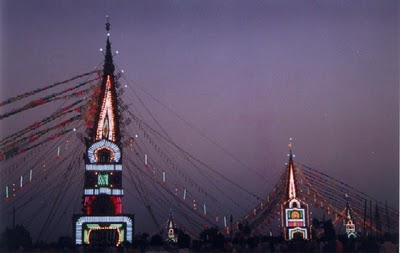
'Prabhas', rectangular frames tapering at the top made of bamboo and decorated with colored cloth and paper, of different sizes are taken in procession as part of the festival. Most of them are 60 to 70 feet high and are carried by the devotees. But the giant prabhas, rising to a height of over 100 feet, are carried on decorated and lighted bullock carts accompanied by a large following. They are placed on a meadow at the foot of the hill. 

Sabarimalai Ayyappa Temple

Lord Ayyappa
Sabarimalai is situated amidst the dense forests in Sahya hill (Sahyadri) range in Pathanamthitta District of Kerala. The temple (Sannidhanam) is located on the hill top, at an altitude of 4135 ft.To reach the temple, one has to trek through the hill by walk in the dense forest range. According to both history and mythology, Lord Ayyappa is the last and only God belonging to the present Kaliyugam.

A demon female called Mahishi, performed severe penance towards Lord Brahma to take revenge against Devas who were responsible for the death of her brother Mahishasura. Mahishasura was killed by Mahishasuramardhini (Kali) as per Devas’ prayers.Lord Brahma appeared to Mahishi and told her that she can ask for any boon except immortality. Mahishi prayed Lord Brahma that she should get such powers that no one should be able to kill her except a son who is born out of the union of Lord Shiva and Lord Vishnu.

She cleverly asked such a boon as both Lord Shiva and Lord Vishnu were male Gods. Brahma offered her the boon. Mahishi started troubling Devas as the revenge.A demon king called Bhasmaasura performed penance praying Lord Shiva. When Lord appeared to him, he asked for a boon that whoever he touches should turn into ashes. The Lord granted him the boon. Bhasmaasura just couldn’t believe it and wanted to test it on Lord Shiva Himself. Lord Shiva went and requested Lord Vishnu to rescue him. Lord Vishnu took the form of a Mohini (a beautiful woman), and went to Bhasmaasura. On seeing her beauty, he wanted to marry her.

Mohini agreed to it with a condition that he should touch his head and swear that he will not think of any other woman after marrying Mohini. Bhasmaasura innocently touched his own head and turned into ashes.

Lord Shiva saw Lord Vishnu who was in the avatar of Mohini. He got attracted with the beauty of Mohini, and there happened the union of Lord Shiva and Mohini (Lord Vishnu), out of which a male child was born to them. He was named Dharma Saastha who was growing up in Kailash, the abode of Lord Shiva. He was also called Hariharan as he was born to Hari (Vishnu) and Hara (Shiva). During the Pandya dynasty, while the Pandyas were ruling parts of Kerala apart from Tamilnadu, the descendants of the dynasty were given the rights to rule the country of Pandalam.

One such king called Rajasekara, who was the direct descendant of the Pandya dynasty was ruling Pandalam region. King Rajasekara was very successful as a king, keeping his kingdom prosperous. The king had only one worry in life that he had no children to take up the responsibility after his tenure. The king and the queen prayed Lord Shiva for blessing them with a child. Lord Shiva decided to answer their prayers through Dharma Saastha. He directed Dharma Saastha to be born as a baby and grow up in Pandalam. Lord Shiva along with Mohini left the baby in the dense forests on the banks of River Pampa, which was in Pandalam territory of Rajasekara.One day, while Rajasekara went for hunting, he was resting in a place after a tiresome hunt. He heard a noise of a baby crying.

Rajasekara Hunting in Forest
Rajasekara Found Ayyappa in Forest
He went around and saw a beautiful male baby left alone in the forest. He was astonished to see the baby with a golden bell tied around the neck. While he was confused on what to do with the baby, a sage who was passing by told him that the baby is so divine and reminded the king of his prayers to Lord Shiva for blessing him with a baby. He also said that the baby is not a normal human being and an avatar of God himself.As there was a bell tied around the neck, the sage named the baby "Manikandan" (Mani means bell and Kanda means neck in Tamil) and advised the king to take the baby to the palace and bring him up. He also told that the king would realize the purpose of the boy’s birth when He turns 12.

The king was too happy and took the baby to the palace and brought him up. The queen and everyone in the kingdom were very happy that the king now had an heir to succeed.There was a Diwan (minister) in the kingdom, who was planning to take over the rule as the king didn’t have a successor, now got worried as his dreams were shattering. As the child grew up the king put him Gurukulam, where he learnt various arts and excelled. Everyone was surprised to see Manikandan being the best among others, with his brilliance and divinity.After completing his studies from his Guru, Manikandan wanted to offer Guru Dhakshina to him. Guru said that his only worry was about his son, who was dumb. Manikandan made him speak instantly.

Guru was too happy about his son who got back his speech and to see the divine powers of Manikandan. Few years later, the queen gave birth to another male child. They named him Raja Rajan. Both the sons grew up happily. One day king Rajasekara decided that the time has come to crown Manikandan as his successor, as he was the eldest. He ordered the Diwan to make necessary arrangements. But the Diwan was not for it as he already had a grudge against Manikandan.He went to the queen and spoiled her mind and made her go against the king’s decision. He told the queen that only Raja Rajan is qualified to be a successor, as he was actually born to them. The queen took his words and started believing him. 

He also told that he will take care of elimination of Manikandan, so that the queen won’t be blamed. He told the queen to act as if she had a severe stomach pain. The queen followed his words and started acting as if she suffered an intolerable stomach pain. Diwan arranged for a doctor who told the king that, the only medicine for queen’s pain is the Tigress’ milk.While the king was planning to send his men for it, Manikandan volunteered to go to the forest and fetch the tigress’ milk, for which the king refused, as Manikandan was proposed to be crowned. But Manikandan insisted and made the king to accept him go.


Manikandan went alone into the forests to fetch milk from tigress. He carried a bag on his head containing necessary food etc., during his search in the forest.On his way, he realized the purpose of his incarnation on earth. As Mahishi had a boon that she can only be killed by a son born to Lord Shiva and Lord Vishnu, Ayyappan realized his duty to save Devas from Mahishi. By then Mahishi was at her peak in devastating Devas and their places. Manikandan on his way to forest pulled her for a fight and waged a strenuous battle with her. Knowing this, Lord Shiva came down to earth along with Parvathi Devi on His Rishaba Vaahana (Ox – His carrier). 

He tied the Ox in a near by tree in the forest and watched Manikandan fighting with Mahishi. The place where he tied the Ox is called as kallaikatti is located on the way to Sabarimalai. There is a Shiva temple now at Kaalai Katti.Manikandan defeated Mahishi and threw her on the ground. Doubting that she may come alive again, Manikandan threw huge stones on her to ensure that she can’t come up again.This place is called Kallidum Kunru on the Alludha Hill, where even today, pilgrims pick up a stone from Azhudha River and throw it in this place marking Mahishi’s defeat.

Ayyappa Defeated Mahishi
Once Mahishi died, Manikandan blessed her to reach heaven. Mahishi who got relieved of some past curse with an opportunity to die from the hands of God Himself, prayed Manikandan to marry her. But He refused saying that, his birth on earth had a different purpose and he was meant to live as a Brahmachari throughout. But as Mahishi insisted, Manikandan told her that she can take abode in the same forest meant for him and assured her that whenever there is no new devotee coming to see Him, He would marry her.From then Mahishi took abode just near the Sannidhanam with the name Maligapurathamma. Till today, she is eagerly waiting to see that no new devotee is visiting Ayyappan, but in vain. Because, every year, thousands of first timers (called Kanni Samis) visit Sabarimalai.

To mark their visit, they bring a sharp bamboo stick called Saram and fix it on a tree at a place called Saram kutti.It is believed that when there is no "Saram" fixed on the tree, Lord Ayyappa would marry her, which never happened.On seeing Manikandan killing Mahishi, Lord Shiva and all Devas were too happy and showered him with praises. Lord Indra, along with all Devas volunteered to become tigers and tigresses and accompanied Manikandan back to the kingdom.Manikandan entered the palace sitting on a tiger, followed by a huge group of tigresses. The entire Pandalam and Palace was shocked to see this happening.
Everyone started running for life on seeing this.Rajasekara realized that Manikandan was not an ordinary child. As told by the sage in the forest that Manikandan’s intent of birth would be known at his age of 12, Manikandan had reached the age of 12 by then. The queen and diwan fell at Manikandan’s feet for His pardon. But Manikandan said it’s not their mistake and everything happened for a cause, with God’s blessings.

King Rajasekara apologized with Manikandan and requested him to take up the throne which was his dream of life. Manikandan politely refused and said that, becoming a king was not the purpose of his birth. He said His duty on earth is over and wanted to perform penance to reach back to Kailash.King Rajasekara told Manikandan that he wished to construct a temple for Him, in a place wherever He chooses. Manikandan took his bow and shot an arrow, saying that he would be on Thapas in the place where the arrow falls. The arrow went and fell at this place called Sabarimalai, which was already a holy place, where an old lady called Sabari, a devotee of Rama lived.

She always was chanting the name of Rama and wanted to meet Him at least once in her life time. Rama met her in this place and accepted her hospitality. As Sabari lived in this hilly forest, it was called Sabarimalai.Manikandan said that he would be meditating in Sabarimalai and would be called as Ayyappan by his devotees. He also said that whoever visits him has to undergo a severe Brahmacharya (fast) and must abstain from worldly pleasures for 41 days before coming to Sabarimala. He would be blessing the devotees from Sabarimala near the river Pampa, which is as sacred as River Ganga.
Pampa River
Rajasekara who was eager to see Ayyappan as a king, felt very sad to see him as a Sanyasi with saffron clothes. Ayyappan granted a boon to Rajasekara that, every year on Makara Sankaranthi day, He would give Dharshan to the world as a king, with all costumes and weapons, a king would adorn.


Makara Jyothi

(The Makara Jyothi is a claimed (not verified) star which millions of Hindus believe to be a sort of celestial and godly manifestation. They claim that seeing this star on Makar Sankranti day brings them good luck and blessing.
The appearance of this star also indicates the end of the Sabarimala pilgrimage which lasts 41 days. )
He also said that He would give appear in the form of a Jyothi (light) on that day, which happens till today on every Sankaranthi. After this, Manikandan proceeded to Sabarimalai on his celestial journey.Later, king Rajasekara, as per advice of Sage Agasthiyar, laid the foundation for constructing the shrine for Ayyappan in the said place. 
Ayyapa Temple - Sabarimala
When king Rajasekara didn’t know how to personify the image of Ayyappan in the temple, Sage Parasurama came to his help, carved the image of Lord Ayyappan and installed it on the day of Makara Sankaranthi.The temple shall be reached by walk either from Erumeli is strenuous and about 48 kms (approx.) by walk.

The route from Pampa is about 6 kms which is shorter but steeper too. People also take another route to reach the temple which is called Pul Medu (meaning Grass Hills).


Padi Pooja


Ayyappa Temple

Ayyappa Temple

Ayyappa Temple with 18 Steps