భారతదేశపు చారిత్రాత్మక దేవాలయాలు

Did you know drinking tea enhances your heart and bone health?


International Tea Day is observed on December 15, and celebrated in tea producing countries like India, Bangladesh, Sri Lanka, Nepal, Vietnam, Indonesia, Kenya and Malaysia. It aims to draw global attention of governments and citizens to the impact of the global tea trade on workers and growers, and has been linked to requests for price supports and fair trade.
Tea is the most widely consumed beverage after water in the world and it can be found in almost 80 percent of all American households, according to teausa.com.
Here are some amazing health benefits of drinking tea:
Good for heart health
Tea is found to enhance your heart health as per a study which revealed that drinking three cups of green tea per day helps in reducing the risk of heart attack by 20 percent and it even deducts the risk of heart stroke by 35 percent. Not just this, it also depletes the LDL or bad cholesterol levels (Low-density lipoprotein)
Maintains bone health
A study found that drinking black tea and green tea can help in curbing bone loss. If you don't believe us have a look at this:
TODAY.com
Keeps cavity at bay
According to Japanese researchers, drinking tea helps in protecting the teeth enamel and also fights cavities by changing the pH level in your mouth.
Helps in shedding weight
Tea is found to be a very effective weight-shedding beverage, consuming green tea, black tea or herbal tea every morning helps in losing weight naturally. Drinking tea without sugar is a healthier option you could opt.
Antioxidants
It provides you with antioxidants which help in combating cancer, boosting immunity and also helps you look young.
These are some amazing health benefits of having cuppa, so enjoy yours today!
Courtesy: Yahoo

Un-Healthy Drinks on the Planet

From soda and iced tea to lemonade and wholesome looking juices, these are the sips that should never pass your lips.
Many of us grew up in homes where soda was the go-to beverage of choice for family dinners and school celebrations. Nowadays, parents across the nation are shamed if they're seen sipping the stuff—or worse—serving it to their little ones.

And it's not your imagination, sugary and diet drinks have indeed become tabu which has resulted in fewer people drinking soda. Sales of carbonated soft drinks in America have dropped for 11 consecutive years, with consumption of the bubbly stuff hitting a 30-year low earlier this year, according to a report from Beverage Digest.
So why aren't we all losing weight and shedding belly fat? Soda has been named public enemy number one, so it's only logical to assume if we all stay away from Coca-Cola, Sprite, and Dr. Pepper, the pounds will melt away—and in theory, that's 100 percent true. However, there's one big problem: Very few of us are swapping soda for plain ol' H20. Instead, we're looking to other beverages like juices and flavored waters to fill the void. While many of these soda alternatives market themselves as the "healthier choice" that's not always the case.
1. Beverage Concentrates
Considering most of these beverage flavoring agents are made with sketchy artificial sweeteners like acesulfame and sucralose, we advise you to stay away. While acesulfame is believed to have carcinogenic properties, sucralose is a sweetener that's been found to mess with your body's satiety signals. What's more, they're filled with potentially harmful dyes like red 40 and yellow 6 which are contaminated with known carcinogens
2. Super-seized Coffees
While a cup of two of coffee can do your body good, you may want to think twice before sizing up to a large or indulging in a fourth cup of Joe. The reason: Doing so may make your bone brittle. "I try to avoid excessive caffeine," says Dr. Mamta M. Mamik, Assistant Professor of Obstetrics, Gynecology and Reproductive Science at the Icahn School of Medicine at Mount Sinai. "An adult can safely consume up to 400 milligrams of caffeine a day (which is equivalent to four 8-ounce cups of coffee), but drinking any more than that can cause calcium excretion, which, over time, may lead to osteoporosis. Avoiding excess caffeine also helps to ward off uncomfortable withdrawal symptoms like lethargy, insomnia, headaches, and irritability," she adds.

3. Vitamin Enhanced Waters
While they may have "water" in their name, these bottled beverages are 120 calories each, and every single one of those calories comes from sugar. And it's not just a little bit of sugar, either. There are 31 grams of in a 20-ounce bottle of Vitamin water, which is 7 and ¾ teaspoons of the sweet stuff.

4. Iced Tea
Spiked with propylene glycol alginate (which is just a fancy name for automotive antifreeze) fast food iced tea is a definite no-go in our book! Propylene glycol alginate is a food thickener, stabilizer, and emulsifier that can cause cardiovascular or neurotoxic issues. But that doesn't stop Dunkin Donuts and other fast food joints from adding it into their iced tea. 

5. Diet Soda
What do cancer-causing artificial colors, flame retardants, and fat-causing fake sugars all have in common? They're all in your favorite diet fizzy drinks. Shove all that into a bottle laced with BPA, a chemical that's been linked to obesity, and you've pretty much got one of the worst drinks ever. Nearly all popular diet sodas contain aspartame, an artificial sweetener that was initially developed to aid weight loss but has recently been found to have the opposite effect. 
"Sugar substitutes like aspartame are designed to promote weight loss and decrease the incidence of metabolic syndrome, but a number of clinical and epidemiologic studies have suggested that these products don't work very well and may actually make things worse," says Richard Hodin, MD, lead author of a recent study on the matter.
6. Liquid Coffee Creamer
Coffee creamer and sunblock have more in common that you might think. They both contain titanium dioxide, an ultraviolet radiation blocker that doubles as a whitening agent. The additive has been proven to cause liver and tissue damage in mice, and may also have health implications in humans, according to a recent review of the chemical. Coffee creamer is also typically sprinkled with trans fats, often hiding under its lesser-known name: hydrogenated oil. Aside from its connection to compromised heart health, the ingredient that has been shown to diminish memory in adults under 45 years old. Many brands also use TBHQ in their recipes, which is a form of butane. Yuck! So what should you put into your morning cup instead? Plain ol' cow's milk or if you're looking for a hint of flavor, stick with a tablespoon of one of Coffee Mate's Natural Bliss creamers. Unlike conventional brands, they're all made from nonfat milk, heavy cream, sugar and natural flavors
7. Frozen Cocktails
While whipping up a frozen marg at home isn't quite as bad as getting it from a bar (400 calories vs. 700), it's still the worst cocktail for your waistline. Made with a sugar-spiked neon mix and tequila, the summer staple will overload your system with more sugar than you'd find in nine Dunkin' Donuts Apple n' Spice Donuts! Other frozen beverages aren't much better, either. The average strawberry daiquiri, for example, has about 280 calories and 44 grams of sugar per serving. Not to mention, it's also 99 percent high fructose corn syrup. Switch to a glass of bubbly with muddled strawberries and lemon slices to get your fruity fix for a fraction of the waist-widening calories.
8. Fruit Juices
Sure, it's natural and overflowing with vitamin C, but it's loaded with sugar—and totally void of any nutrients like fiber or protein to help slow the sugar spike. An average glass packs 36 grams of sugar —or about what you'd get from popping 4 Krispy Kreme glazed donuts into a blender and hitting frappe. What's more, most of the sweetness in juice comes from fructose, a type of sugar associated with the development of belly fat. A better drink for citrus lovers? Water flavored with fresh slices of oranges, lemon, and grapefruit. For added benefits, keep the peels on. Citrus peels contain the antioxidant d-limonene, a powerful compound that helps flush out stored visceral fat.
9. Conventional Skim Milk
While skim milk may be lowest in calories, many of its vitamins are fat-soluble, which means you won't get all the benefits of the alphabetical nutrients listed on your cereal box unless you opt for at least 1%. Why's it important to opt for grass-fed, organic cartons over the conventional stuff? Not only does it taste better and stay fresh longer, when the herds graze on grass instead of feed, their milk has higher levels of omega-3s and CLA (conjugated linoleic acid), a nutrient that boosts immunity, improves bone mass, and even reduce body fat—gotta love that!
10.Canned Energy Drinks
These overpriced chemical cocktails may give you a surge of energy, but they're riddled with harmful sweeteners (many of which made our list of these Best and Worst Popular Sweeteners) and are even more corrosive to your teeth than regular soda. Just say no to these icky drinks!

and also following 20 more drinks which are un healthy:
·         Energy Shots
·         Fancy Coffee Drinks
·         Slushies
·         Bottled Smoothies
·         Sports Drinks
·         Milkshakes
·         Conventional Bottled Nutrition Shakes
·         Bottled Water
·         Cola
·         Fruity Sodas
·         Sweetened Milk Alternatives
·         Bottled Alcoholic Mixers
·         Eggnog
·         Commercial Hot Cocoa
·         Mudslides
·         Ginger Beer
·         Orange Drinks
·         Lemonade
·         Certain Bottled Teas
·         Powdered Fruit Drinks

Courtesy: Yahoo

Katas Raj Temples, Chakwal, near Lahore, Punjab

Katas Raj Temple is situated in Chakwal district of Punjab in Pakistan. Dedicated to Lord Shiva, the temple has existed before the days of Mahabharata and the Pandava brothers spent a substantial part of their exile here.

It is said that the five Pandava brothers, heroes of the Historical epic Mahabharata, stayed here four out of the 14 years that they spent in exile.

Its origin involves the death of Shiva's wife Satti. When she died, Shiva cried so much and for so long, that his tears created two holy ponds - one at Pushkar in Ajmer, India and the other at the Katas Raj Temple.

Gorakhnath Temple, Peshawar - Pakisthan

Gorakhnath Temple, Peshawar, NWFP

A historic Hindu temple in Peshawar city of northwest Pakistan, which was re-opened on the orders of a court last year, has been vandalised by unidentified men in the third such attack on the shrine in the past two months.

The attackers burnt pictures inside Gorakhnath Temple and took away idols from the shrine located within an archaeological complex in Gor Gathri area on Sunday, leaders of the Hindu community said.

The shrine’s custodian told the media that this was the third attack on the temple in the past two months. Police officers visited the temple to probe the incident.
Hindu leaders urged police to put in place better security measures to prevent such incidents.
The temple’s custodian told police that he had seen a group of eight men inside the temple when he arrived there at 6:30 p.m.
The men started burning pictures and holy books before fleeing with some idols, he said.
Members of the minority Hindu community rushed to the temple.
Footage on television showed burnt papers and utensils lying strewn on the floor of the temple.
The 160-year-old temple was re-opened for Hindus last year on the orders of the Peshawar High Court. It had been closed since Partition.
The temple was reopened after Phool Wati, the daughter of the shrine’s cleric, petitioned the High Court. 

Courtesy:The Hindu

Pictures about Ramayana

Asoka Vanam

Foot prints of Lord Hanuman
Ravana Palace
Sanjhivini Paravatham Brought by Lord Hanuman

Rama Sethu - The Floating stones bridge 
Floating Stone used to build Bridge on Sea
Rama Sethu

Sugreeva Cave
Ariel view of Sugreeva Cave

GOD PARTICLE mentioned in VEDAS

Scientists at the massive Large Hadron Collider under the Swiss Alps have easily replicated the innovative mini-Big Bang results of a previous experiment which created the ‘primordial soup’ of the just-born universe.
God Particle
Super-hot ‘quark-gluon plasma’ is believed to have existed just nano-seconds after the Big Bang, and to have formed the stuff of galaxies, planets, suns, and all life forms. Such new data on the birth of the universe is pouring in from the experiments, leading physicists to consider extending the current phase of the project for two more years.
The new results took only days of colliding lead ions in the massive machine at ultra-high energies, and produced temperatures 500,000 times higher than in the sun’s core. The resultant mini-Big Bangs were even more intense than those caused using hydrogen protons during the Collider’s first seven months of operation.

The planned two-year extension could result in earlier discovery of the Higgs Boson particle believed to be the stimulus which changed the initial fabric of the universe, an amorphous mass of particles, into solid matter.
 
Lord Sree Maha Vishnu
According to CERN Director General Rolf Heuer, scientists working on the project want to maintain the momentum of the new discoveries, as everything previously understood has now been confirmed and new territories are waiting to be explored. The ‘known unknowns’ are coming into view, and the as yet unimaginable lies beyond.
The Large Hadron Collider is at present being shut down for its regular winter maintenance schedule and experiments will recommence in February next year.

Statue of Lord Shiva Pictures at Hrishikesh - Uttarakand


Sri Kanakadhara Stotram

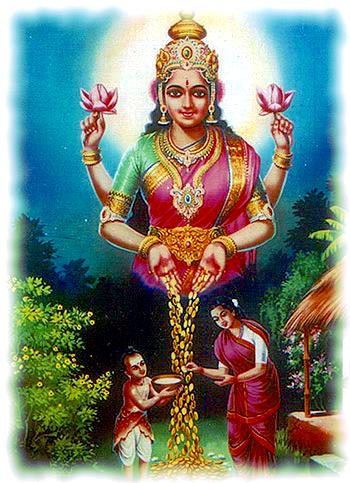
Goddess MahaLakshmi

Birth of Kanakadhara stotram :

Adi Sankara was one of the greatest philosophers of all time. He was born in a poor Brahmin family in Kerala. After brahmopadesa, as is usual during those times, he was asked to beg alms for his lunch. One day when he went to a Brahmin house, the lady of the house was so poor that she did not have anything to give him. She searched hard and found one small fruit of gooseberry, which she gave to Sankara, the boy. He was so touched by her gesture that he sang these 21 mellifluous hymns on Goddess Lakshmi, who poured golden goose berries as rain to the poor woman’s house. Even today it is believed that poverty would be banished by singing this hymn.

Sloka-1 Angam hare pulaka bhooshanamasrayanthi,
Bhringanga neva mukulabharanam thamalam,
Angikrithakhila vibhuthirapanga leela,
Mangalyadasthu mama mangala devathaya.

To the Hari who wears supreme happiness as Ornament,
The Goddess Lakshmi is attracted,
Like the black bees getting attracted,
To the unopened buds of black Tamala[1] tree,
Let her who is the Goddess of all good things,
Grant me a glance that will bring prosperity.

Sloka-2 Mugdha muhurvidhadhadathi vadhane Murare,
Premathrapapranihithani gathagathani,
Mala dhrishotmadhukareeva maheth pale ya,
Sa ne sriyam dhisathu sagarasambhavaya.

Again and again return ,those glances,
Filled with hesitation and love,
Of her who is born to the ocean of milk,
To the face of Murari[2],
Like the honey bees to the pretty blue lotus,
And let those glances shower me with wealth.

Sloka-3 Ameelithaksha madhigamya mudha Mukundam
Anandakandamanimeshamananga thanthram,
Akekara stiththa kaninika pashma nethram,
Bhoothyai bhavenmama bhjangasayananganaya.

With half closed eyes stares she on Mukunda[3],
Filled with happiness , shyness and the science of love,
On the ecstasy filled face with closed eyes of her Lord,
And let her , who is the wife of Him who sleeps on the snake,
Shower me with wealth.

Sloka-4 Bahwanthare madhujitha srithakausthube ya,
Haravaleeva nari neela mayi vibhathi,
Kamapradha bhagavatho api kadaksha mala,
Kalyanamavahathu me kamalalayaya

He who has won over Madhu[4],
Wears the Kousthuba[5] as ornament,
And also the garland of glances, of blue Indraneela[6],
Filled with love to protect and grant wishes to Him,
Of her who lives on the lotus,
And let those also fall on me,
And grant me all that is good..

Sloka-5 Kalambudhaalithorasi kaida bhare,
Dharaadhare sphurathi yaa thadinganeva,
Mathu samastha jagatham mahaneeya murthy,
Badrani me dhisathu bhargava nandanaya

Like the streak of lightning in black dark cloud,
She is shining on the dark , broad chest,
Of He who killed Kaidaba[7],
And let the eyes of the great mother of all universe,
Who is the daughter of Sage Bharghava[8],
Fallon me lightly and bring me prosperity.

Sloka-6 Praptham padam pradhamatha khalu yat prabhavath,
Mangalyabhaji madhu madhini manamathena,
Mayyapadetha mathara meekshanardham,
Manthalasam cha makaralaya kanyakaya.

The God of love could only reach ,
The killer of Madhu[9],
Through the power of her kind glances,
Loaded with love and blessing
And let that side glance ,
Which is auspicious and indolent,
Fall on me.

Sloka-7 Viswamarendra padhavee bramadhana dhaksham,
Ananda hethu radhikam madhu vishwoapi,
Eshanna sheedhathu mayi kshanameekshanartham,
Indhivarodhara sahodharamidhiraya

Capable of making one as king of Devas in this world,
Her side long glance of a moment,
Made Indra[10] regain his kingdom,
And is making Him who killed Madhu [11] supremely happy.
And let her with her blue lotus eyes glance me a little.

Sloka-8 Ishta visishtamathayopi yaya dhayardhra,
Dhrishtya thravishta papadam sulabham labhanthe,
Hrishtim prahrushta kamlodhara deepthirishtam,
Pushtim krishishta mama pushkravishtaraya.

To her devotees and those who are great,
Grants she a place in heaven which is difficult to attain,
Just by a glance of her compassion filled eyes,
Let her sparkling eyes which are like the fully opened lotus,
Fall on me and grant me all my desires.

Sloka-9 Dhadyaddhayanupavanopi dravinambhudaraam,
Asminna kinchina vihanga sisou vishanne,
Dhushkaramagarmmapaneeya chiraya dhooram,
Narayana pranayinee nayanambhuvaha.

Please send your mercy which is like wind,
And shower the rain of wealth on this parched land,,
And quench the thirst of this little chataka[12] bird,
And likewise ,drive away afar my load of sins,
Oh, darling of Narayana[13],
By the glance from your cloud like dark eyes.

Sloka-10 Gheerdhevathethi garuda dwaja sundarithi,
Sakambhareethi sasi shekara vallebhethi,
Srishti sthithi pralaya kelishu samsthitha ya,
Thasyai namas thribhvanai ka guros tharunyai.

She is the goddess of Knowledge,
She is the darling of Him who has Garuda[14] as flag,
She is the power that causes of death at time of deluge,
And she is the wife of Him who has the crescent,
And she does the creation , upkeep and destruction at various times,
And my salutations to this lady who is worshipped by all the three worlds.

Sloka-11 Sruthyai namosthu shubha karma phala prasoothyai,
Rathyai namosthu ramaneeya gunarnavayai,
Shakthyai namosthu satha pathra nikethanayai,
Pushtayi namosthu purushotthama vallabhayai.

Salutations to you as Vedas[15] which give rise to good actions,
Salutation to you as Rathi[16] for giving the most beautiful qualities,
Salutation to you as Shakthi[17] ,who lives in the hundred petalled lotus,
And salutations to you who is Goddess of plenty,
And is the consort of Purushottama[18].

Sloka-12 Namosthu naleekha nibhananai,
Namosthu dhugdhogdhadhi janma bhoomayai,
Namosthu somamrutha sodharayai,
Namosthu narayana vallabhayai.

Salutations to her who is as pretty.
As the lotus in full bloom,
Salutations to her who is born from ocean of milk,
Salutations to the sister of nectar and the moon,
Salutations to the consort of Narayana.

Sloka-13 Namosthu hemambhuja peetikayai,
Namosthu bhoo mandala nayikayai,
Namosthu devathi dhaya prayai,
Namosthu Sarngayudha vallabhayai.

Salutations to her who has the golden lotus as seat,
Salutations to her who is the leader of the universe,
Salutations to her who showers mercy on devas,
And salutations to the consort of Him who has the bow called Saranga.

Sloka-14 Namosthu devyai bhrugu nandanayai,
Namosthu vishnorurasi sthithayai,
Namosthu lakshmyai kamalalayai,
Namosthu dhamodhra vallabhayai.

Salutations to her who is daughter of Bhrigu[19],
Salutations to her lives on the holy chest of Vishnu,
Salutations to Goddess Lakshmi who lives in a lotus,
And saluations to her who is the consort of Damodhara[20].

Sloka-15 Namosthu Kanthyai kamalekshanayai,
Namosthu bhoothyai bhuvanaprasoothyai,
Namosthu devadhibhir archithayai,
Namosthu nandhathmaja vallabhayai.

Salutations to her who is light living in Lotus flower,
Salutations to her who is the earth and also mother of earth,
Salutations to her who is worshipped by Devas,
And salutations to her who is the consort of the son of Nanda[21].

Sloka-16 Sampath karaani sakalendriya nandanani,
Samrajya dhana vibhavani saroruhakshi,
Twad vandanani dhuritha haranodhythani,
Mamev matharanisam kalayanthu manye.

Giver of wealth, giver of pleasures to all senses,
Giver of the right to rule kingdoms,
She who has lotus like eyes,
She to whom Salutations remove all miseries fast,
And my mother to you are my salutations.

Sloka-17 Yath Kadaksha samupasana vidhi,
Sevakasya sakalartha sapadha,
Santhanodhi vachananga manasai,
Twaam murari hridayeswareem bhaje

He who worships your sidelong glances,
Is blessed by all known wealth and prosperity,
And so my salutations by word, thought and deed,
To the queen of the heart of my Lord Murari[22].

Sloka-18 Sarasija nilaye saroja hasthe,
Dhavalathamamsuka gandha maya shobhe,
Bhagavathi hari vallabhe manogne,
Tribhuvana bhoothikari praseeda mahye

She who sits on the Lotus,
She who has lotus in her hands,
She who is dressed in dazzling white,
She who shines in garlands and sandal paste,
The Goddess who is the consort of Hari,
She who gladdens the mind,
And she who confers prosperity on the three worlds,
Be pleased to show compassion to me.

Sloka-19 Dhiggasthibhi kanaka kumbha mukha vasrushta,
Sarvahini vimala charu jalaapluthangim,
Prathar namami jagathaam janani masesha,
Lokadhinatha grahini mamrithabhi puthreem.

Those eight elephants from all the diverse directions,
Pour from out from golden vessels,
The water from the Ganga[23] which flows in heaven,
For your holy purifying bath,
And my salutations in the morn to you ,
Who is the mother of all worlds,
Who is the house wife of the Lord of the worlds,
And who is the daughter of the ocean which gave nectar[24].

Sloka-20 Kamale Kamalaksha vallabhe twam,
Karuna poora tharingithaira pangai,
Avalokaya mamakinchananam,
Prathamam pathamakrithrimam dhyaya

She who is the Lotus,
She who is the consort,
Of the Lord with Lotus like eyes,
She who has glances filled with mercy,
Please turn your glance on me,
Who is the poorest among the poor,
And first make me the vessel ,
To receive your pity and compassion.

Sloka-21 Sthuvanthi ye sthuthibhirameeranwaham,
Thrayeemayim thribhuvanamatharam ramam,
Gunadhika guruthara bhagya bhagina,
Bhavanthi the bhuvi budha bhavithasayo
.

He who recites these prayers daily,
On her who is personification of Vedas,
On her who is the mother of the three worlds,
On her who is Goddess Rema[25],
Will be blessed without doubt,
With all good graceful qualities,
With all the great fortunes that one can get,
And would live in the world,
With great recognition from even the learned.

Translated by P. R. Ramachander

[1] A forest tree
[2] The God who killed the asura called Mura i.e Lord Vishnu
[3] He who gives immortal bliss
[4] An Asura
[5] A garland wirn by Vishnu
[6] A precious blue stone
[7] An Asura
[8] One sage who did penance to have goddess Lakshmi as his daughter and succeeded.
[9] An asura
[10] King of Devas
[11] An Asura
[12] A mythical bird which is always thirsty.
[13] Name of Lord Vishnu
[14] A mythical eagle on which Lord Vishnu travels
[15] Holy books of Hindus
[16] Wife of the God of Love
[17] Goddess parvathy
[18] Greatest among men , a name of Lord Vishnu
[19] Another name for sage Bharghava referred earlier.
[20] He who was tied by a rope in the stomach –a name of Lord Krishna.
[21] Nanda Gopa the foster father of Lord Krishna
[22] He who killed the asura called Mura
[23] The holiest river for Hindus
[24] Goddess Lakshmi was supposed to have come out of the ocean of milk during churning .Nectar along with many things also came out similarly.
[25] A name of Goddess Lakshmi 

Bhagavad Gita - Chapter-7, Verse-8

raso 'ham apsu kaunteya
prabhasmi sasi-suryayoh
pranavah sarva-vedesu
sabdah khe paurusam nrsu


SYNONYMS
rasah--taste; aham--I; apsu--in water; kaunteya--O son of Kunti; prabha asmi--I am the light; sasi-suryayoh--in the sun and the moon; pranavah--the letters A.U.M.; sarva--in all; vedesu--in the Vedas; sabdah--sound vibration; khe--in the ether; paurusam--ability; nrsu--in man. 

TRANSLATION
O son of Kunti [Arjuna], I am the taste of water, the light of the sun and the moon, the syllable om in the Vedic mantras; I am the sound in ether and ability in man.

PURPORT

This verse explains how the Lord is all-pervasive by His diverse material and spiritual energies. The Supreme Lord can be preliminarily perceived by His different energies, and in this way He is realized impersonally. As the demigod in the sun is a person and is perceived by his all-pervading energy, the sunshine, similarly, the Lord, although in His eternal abode, is perceived by His all-pervading, diffusive energies. The taste of water is the active principle of water. No one likes to drink sea water because the pure taste of water is mixed with salt. Attraction for water depends on the purity of the taste, and this pure taste is one of the energies of the Lord. The impersonalist perceives the presence of the Lord in water by its taste, and the personalist also glorifies the Lord for His kindly supplying water to quench man's thirst. That is the way of perceiving the Supreme. Practically speaking, there is no conflict between personalism and impersonalism. One who knows God knows that the impersonal conception and personal conception are simultaneously present in everything and that there is no contradiction. Therefore Lord Caitanya established His sublime doctrine: acintya-bheda and abheda-tattvam--simultaneously one and different.
     The light of the sun and the moon is also originally emanating from the brahmajyoti, which is the impersonal effulgence of the Lord. Similarly pranava or the omkara transcendental sound used in the beginning of every Vedic hymn to address the Supreme Lord also emanates from Him. Because the impersonalists are very much afraid of addressing the Supreme Lord Krsna by His innumerable names, they prefer to vibrate the transcendental sound omkara. But they do not realize that omkara is the sound representation of Krsna. The jurisdiction of Krsna consciousness extends everywhere, and one who knows Krsna consciousness is blessed. Those who do not know Krsna are in illusion, and so knowledge of Krsna is liberation, and ignorance of Him is bondage

Bhagavad-gita Chapter-7 Verse-7


mattah parataram nanyat
kincid asti dhananjaya
mayi sarvam idam protam
sutre mani-gana iva


TRANSLATION
O conqueror of wealth(Arjuna), there is no truth superior to Me(Lord Krishna). Everything rests upon Me, as pearls are strung on a thread.


PURPORT
There is a common controversy over whether the Supreme Absolute Truth is personal or impersonal. As far as Bhagavad-gita is concerned, the Absolute Truth is the Personality of Godhead Sri Krsna, and this is confirmed in every step. In this verse, in particular, it is stressed that the Absolute Truth is a person. That the Personality of Godhead is the Supreme Absolute Truth is also the affirmation of the Brahma-samhita: isvarah paramah krsnah sac-cid-ananda-vigrahah; that is, the Supreme Absolute Truth Personality of Godhead is Lord Krsna, who is the primeval Lord, the reservoir of all pleasure, Govinda, and the eternal form of complete bliss and knowledge. These authorities leave no doubt that the Absolute Truth is the Supreme Person, the cause of all causes. The impersonalist, however, argues on the strength of the Vedic version given in the Svetasvatara Upanisad: tato yad uttarataram tad arupam anamayam ya etad vidur amrtas te bhavanti athetare duhkham evapiyanti. "In the material world Brahma, the primeval living entity within the universe, is understood to be the supreme amongst the demigods, human beings and lower animals. But beyond Brahma there is the Transcendence who has no material form and is free from all material contaminations. Anyone who can know Him also becomes transcendental, but those who do not know Him suffer the miseries of the material world." 
The impersonalist puts more stress on the word arupam. But this arupam is not impersonal. It indicates the transcendental form of eternity, bliss and knowledge as described in the Brahma-samhita quoted above. Other verses in the Svetasvatara Upanisad substantiate this as follows:

vedaham etam purusam mahantam aditya-varnam tamasah parastat tam eva vidvan amrta iha bhavati nanyah pantha vidyate ayanaya yasmat param naparam asti kincid yasman naniyo no jyayo 'sti kincit

"I know that Supreme Personality of Godhead who is transcendental to all material conceptions of darkness. Only he who knows Him can transcend the bonds of birth and death. There is no way for liberation other than this knowledge of that Supreme Person.
"There is no truth superior to that Supreme Person because He is the supermost. He is smaller than the smallest, and He is greater than the greatest. He is situated as a silent tree, and He illumines the transcendental sky, and as a tree spreads its roots, He spreads His extensive energies." 

From these verses one concludes that the Supreme Absolute Truth is the Supreme Personality of Godhead who is all-pervading by His multi-energies, both material and spiritual.

Sri Laxmi Narayan Mantra

Sri Lord Narayana and Goddess Lakshmi

"Om Hreeng Hreeng Shreeng Shreeng Laxminarayanay Namah"

This Mantra is highly beneficial for acquiring financial prosperity and materialistic success. It should be recited 10 lakh times for its Siddhi.

Narayanaya Gayatri Mantra

Lord Narayana


Narayana Gayatri Mantra
 
Om Narayanaya Vidhmahe
Vasudevaya Dheemahe
Tanno Vishnu Prachodayaath
 Vishnu is one of the three main gods of the Hindu trimurti (three forms). The trimurti is often depicted in art as one man with three heads. Brahma is the Creator. Vishnu is the Preserver. Shiva is the Destroyer.

The name Vishnu comes from the Sanskrit root 'vish', meaning to pervade. Some Hindu legends describe Vishnu as an eternal deity, and associate him with the primeval waters that pervaded the world before creation. Another name for Vishnu is Narayana, meaning 'one who moves waters'.

To understand Vishnu's role as Preserver, one must accept two basic Hindu beliefs. The first is that humans may escape the cycle of samsara by following predetermined paths of duty. The second is that good and evil are in constant contention for their reign over the world.

It is believed that whenever evil outweighs good with an opportunity to emerge victorious, Vishnu descends to earth in some mortal form to save humanity. Vishnu is not allowed to tamper with events directly. Rather, he intervenes and guides humans to act in ways that will restore proper balance between good and evil.

The puranas speak of the ten avataars of Vishnu. These incarnations detail the divine help given by Vishnu during various stages of human evolution, by appearing on earth in different forms. These avatars are said to demonstrate that divinity re-establishes Dharma or righteousness and destroys injustice from time to time, by appearing on earth in various incarnations.

The ten avataras are Matsyavatara (fish), Koorma (tortoise), Varaaha (boar), Narasimha (the man lion), Vaamana (the dwarf), Parasurama (the angry man), Rama (the perfect human), Balarama and Krishna (the divine statesman). The 10th avatar which is yet to appear is Kalki.

Matsyavatara, or the form of the fish was taken up by Vishnu during a deluge that submerged the earth. Vishnu commanded a rishi to gather together samples of all species and wait in a boat. The gigantic golden fish then dragged the boat through the deluge and then enabled Bhrama to start the act of creation all over again. Yet another legend has it that a demon once stole the four Vedas and hid them under the sea. Vishnu assumed the Matsya form and retrieved them and then restored them to their original fragrance. This legend is held at the Parimalaranganathar temple at Mayiladuturai, near Thanjavur (Tamilnadu).

The Koorma Avatara where Vishnu took the form of a tortoise, is described in the legend of the celestial nectar Amrita.

Vishnu took the form of a wild boar - the Varaaha Avatara, dived into the ocean, and saved Bhoomi Devi who sank into the bottom of the ocean, with his massive snout. Vishnu as Varahamurthy is enshrined at Tiruvidandai near Chennai, and at the Kanchipuram Kamakshiamman temple.

In his Narasimhaavataaram, Vishnu destroyed the demon king Hiranyakashipu and demonstrated his omnipresence in a powerful way.

Vishnu took the form of Vamana the midget to destroy the demon Bali. He visited Bali during a sacrifice where the latter was arrogantly distributing gifts of the seeker's choice, to show his power of wealth. Vamana meekly asked for three feet of land measured by his small feet. All on a sudden he assumed the massive form of Trivikrama, dominating the universe; with his first foot he covered the earth, with the second the heavens. When there was no room for the third, Bali, who never went back on his word offered his head, and Vishnu sent him to the netherworld. Trivikrama is enshrined at Tirukkovilur, Kanchipuram and Sirkazhi in Tamilnadu.

Vishnu then took up the form of Parasurama, to quell the arrogance of the Kshatriya rulers who harmed the sages and unprotected mortals.

The Ramayana speaks of the glory of the Rama Avatar, and the Mahabharata speaks of Balarama and Krishna.

Some schools of thought believe that Krishna was the eighth incarnation of Vishnu and the ninth was Buddha and that Vishnu took up the avataar of Buddha to purify Hinduism of excessive ritualism. He preached detachment, and the middle path consisting of eight fold virtues of right views, right resolve, right speech, right conduct, right livelihood, right effort, right mindfullness and right meditation.

It is believed that at the end of the current epoch, there will be a deluge when Kalki - the tenth and the last avatara of Vishnu, will ride forth on a horse to redeem humankind and re-establish righteousness.

There is a legend for each one of Vishnu's first nine avatars and how each one intervened to preserve the universally required balance of good and evil. Vishnu's tenth avatar, Kalki, the horseman, has not yet descended to earth. It is believed that his arrival will mark the end of this present age of evil, known as the Kali Yuga.

Vishnu often appears dressed in yellow robes, hence his name Pitambara, or the yellow-vested one. Although his traditional vehicle is a giant mythical bird called Garuda, Vishnu may also be depicted amid the cosmic waters, reclining on the back of the coiled serpent named Sesha.

If Vishnu is depicted as reclining on the back of Sesha, this is a sign that order is prevailing in the cosmos, and a proper balance between good and evil is being maintained throughout the universe. If Vishnu is depicted as riding or standing near Garuda, this is a sign that he is ready to descend to earth and interact with mortals to preserve cosmic order.

Vishnu's wife is Lakshmi, goddess of fortune, wealth, and prosperity. She is often depicted together with Vishnu, seated on Garuda.

Vishnu is a popular deity and is worshipped widely throughout India. He has 1,000 names, and devotees who engage in his name recitation and repetition are believed to accumulate great blessings.